How to Respond to an eBay VeRO Notice Without Losing Your Account
- eBay, eBay Policies & Seller Protection
- 13 min read
Table of contents
A listing that sold steadily for months vanishes overnight, and the email explaining why names a company you have never dealt with. Knowing how to respond to an eBay VeRO notice matters because the wrong response is easy and fast: relist the item, argue with eBay, or ignore the message. Each of those moves a single removal one step closer to a restriction. The right response is slower and involves a party most sellers do not expect to talk to, the rights owner who filed the report.
This guide explains how the Verified Rights Owner programme works, who the rights owner is, what the notice tells you, how to respond to an eBay VeRO notice for each type of claim, when a counter notice applies, and how repeated removals escalate toward the account suspension we covered in our guide to getting a suspended eBay account reinstated.
Key Takeaways
- Main Insight: eBay does not judge whether your item infringed. The rights owner made the claim, and the rights owner is the party able to withdraw it. Your response therefore starts with them, not with eBay support.
- Strategy Tip: End identical listings and hold the inventory before you contact anyone. A second removal for the same item while the first is open is what turns a removal into a pattern on your account.
- User Benefit: Sellers who understand the claim type, gather the matching proof, and answer once and completely tend to keep the account clean, and they learn which products to stop sourcing. That is the whole method in one line.
eBay VeRO Program Explained: Who Filed the Claim
The Verified Rights Owner programme lets intellectual property owners, brands, licensors, photographers, and their agents report listings they believe infringe their rights. eBay’s intellectual property policy describes the programme and lists the enforcement actions it uses: removing the listing or other content, issuing a warning, restricting activity, or suspending the account. Participants submit reports through a dedicated process, and eBay acts on those reports without independently verifying the claim in most cases. eBay’s VeRO programme page is written for rights owners, which itself tells you where the power in the process sits.
That last point changes how you respond. eBay is the messenger and the enforcer, but the rights owner is the complainant. When sellers write long messages to eBay explaining that the item is genuine, they are addressing a party that did not make the accusation and is not positioned to withdraw it. The eBay VeRO program explained in one sentence: a brand says your listing infringes, eBay removes it, and eBay tells you who to talk to.
| Party | Role in a VeRO removal | What they are able to do |
|---|---|---|
| Rights owner | Files the report | Withdraw the report, explain the claim, accept proof |
| eBay | Removes the listing, notifies you, records the event | Reinstate after a retraction, apply enforcement for repeats |
| Seller | Receives the notice | Contact the rights owner, fix the listing, provide proof, submit a counter notice where applicable |
| Buyer | Order cancelled if a sale was pending | Nothing, though cancellations still affect your metrics |
Start by Reading the Notice
The email eBay sends when a VeRO listing is removed contains more than most sellers read on first pass. It names the rights owner or their agent, it identifies the listing or listings ended, it states the category of claim, and it normally includes contact details for the rights owner or a link to their VeRO participant page, where many brands publish what they consider infringing and how to reach them. Working out your response from that email is possible, because the email tells you who to contact and roughly why.
Fees on the removed listing are typically credited, and any open order on it is cancelled. Order cancellations that eBay initiates for policy reasons are treated differently from cancellations you initiate, but the buyer experience is still a failed purchase, which is worth remembering when you weigh whether to relist a borderline item. Our guide to eBay buyer protection for sellers covers how cancellations and cases feed into your account metrics.
The Five Claim Types Behind Most Removals
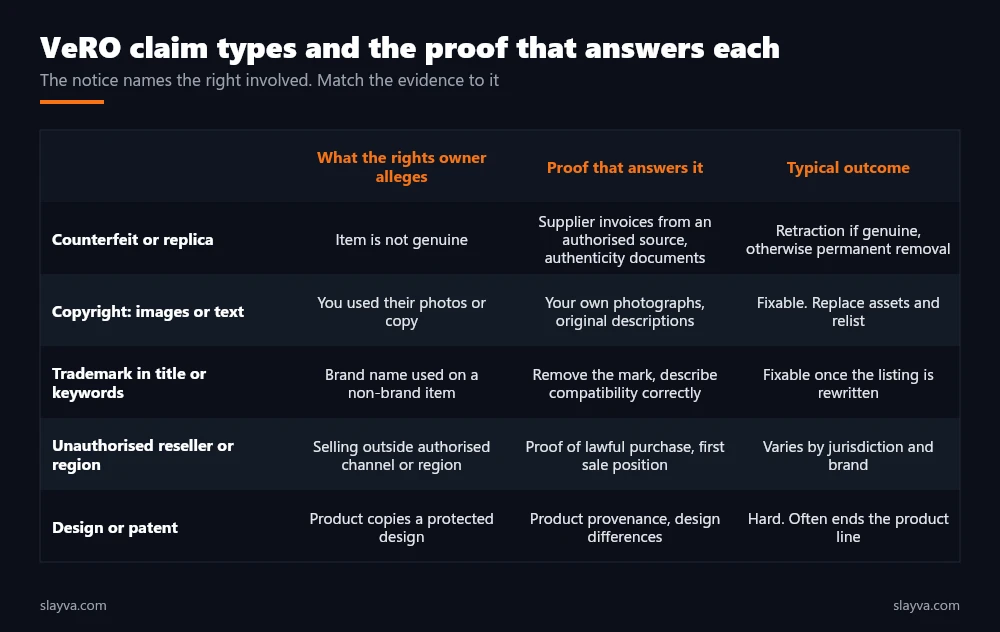
Claims fall into a small number of groups, and the right response depends on which one you received. Counterfeit and replica claims allege the item is not genuine. Copyright claims allege you used the rights owner’s photographs or product text. Trademark misuse claims allege a brand name appears in a title or item specific on a product that brand did not make, the classic “compatible with” problem. Unauthorised reseller or region claims allege you are selling outside the brand’s approved channels or territory. Design and patent claims allege the product itself copies a protected design.
Not sure the claim is valid?
Send us the VeRO notice. We tell you whether to ask the rights owner for a retraction, fix the listing, or leave it, and which other listings carry the same risk.
How to Respond to an eBay VeRO Notice: The Five Step Sequence
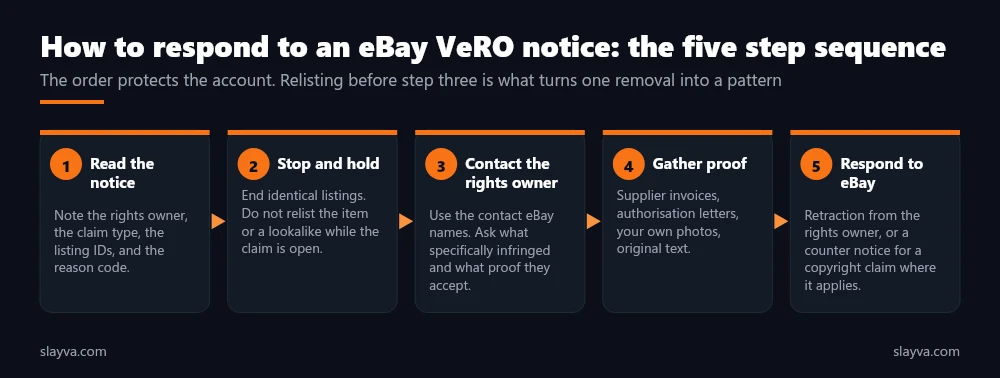
The sequence below is the practical answer. The order is the point. Sellers who jump to step five, or who relist before step three, are the ones we later meet with a restriction.
Step 1: Read the Notice and Record It
Save the email, because your response depends on details in it that are easy to skim past. Note the rights owner’s name, the claim type, every listing ID affected, and the contact route given. Check your Seller Hub messages for a matching policy notice, and check whether other listings for the same product are still live. If the notice references a participant page, read it in full. Brands that publish their VeRO policy usually state what they object to and what evidence they accept, which shortens everything that follows.
Step 2: Stop and Hold After a VeRO Listing Removed Notice
End any identical or near identical listings yourself before eBay does it for you. Do not relist the item, a variant, or a lookalike while the claim is open. This step feels like conceding, and it is the opposite. A second removal for the same product within days is the fastest route from a single event to a policy warning, and warnings are the subject of our guide on handling an eBay account warning. Move the stock aside and treat it as unsellable until the claim is resolved. Holding is the least intuitive step and the part that protects the account most.
Step 3: Contact the Rights Owner
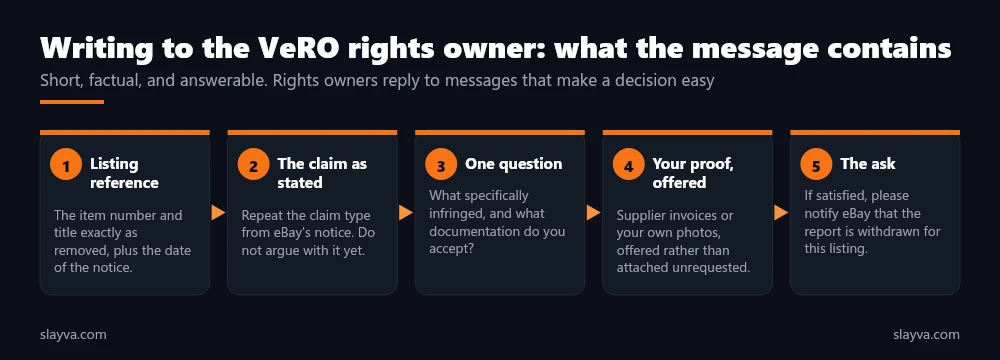
Write to the rights owner using the contact eBay provided. Keep it short and factual: the listing ID, the claim type as stated, a request for the specific reason the listing was reported, and a question about what documentation they accept. If the item is genuine and you hold supplier invoices, say so and offer them. If you used their photographs without realising, say that you have removed them and will use your own. Tone matters. Rights owners deal with counterfeiters daily, and a seller who writes calmly and provides proof stands out. In practice this message is most of the response.
The rights owner is the only party in a VeRO removal who is able to say the claim was a mistake. Every message that goes to eBay instead of to them is a message sent to the wrong desk.
Step 4: Gather the Proof That Matches the Claim
For counterfeit claims, gather supplier invoices that show the supplier’s legal name, address, the item, quantities, and dates, plus any authorisation or distribution agreement. For copyright claims, gather your own photographs and original descriptions to replace the disputed assets. For trademark misuse, prepare a rewritten title and item specifics that describe compatibility without implying the brand made the item. For reseller and region claims, gather proof of lawful purchase. Sellers who source through arbitrage or dropshipping often find at this step that they hold no documentation a rights owner will accept, and that discovery is itself the answer about whether to continue with the product.
Step 5: Close the Case at the eBay End
eBay acts on two things: a retraction from the rights owner, or a valid counter notice for a copyright claim where the law provides one. If the rights owner agrees the report was mistaken, ask them to notify eBay directly, then follow up with eBay referencing the listing ID. If the listing was correctly removed and you have fixed the cause, do not appeal. Relist the corrected version once, after the fix, and keep the rights owner’s guidance on file. The process ends here for most sellers, with either a retraction or a corrected listing.
| Situation | Right response | Wrong response |
|---|---|---|
| Item is genuine, invoices in hand | Send invoices to the rights owner, request retraction | Argue with eBay support |
| Used the brand’s photos or text | Replace with your own, relist once | Relist with the same images |
| Brand name used on compatible item | Rewrite title and specifics, relist once | Move the brand name into the description |
| Copyright claim you believe is wrong | Consider a counter notice where the law provides one | Relist and wait for a second removal |
| Replica or unverifiable source | Exit the product line | List under a different title |
When to Use a VeRO Counter Notice, and When Not To
A VeRO counter notice is a formal statement that you believe a copyright removal was made in error, and that you accept legal responsibility for that position. It exists because copyright takedown frameworks in some jurisdictions, including the notice and takedown process under United States copyright law, give the accused party a route to contest the claim. eBay provides a counter notice process for eligible copyright claims, and the rights owner then has a defined period to take the matter to court or let the content return.
Two limits matter. First, the VeRO counter notice applies to copyright claims, not to trademark, counterfeit, or design claims, which most VeRO removals are. Second, it is a legal declaration, and filing one on a claim you are not confident about exposes you to real liability. When we advise clients on VeRO notices, the counter notice is the tool for one specific case: your own photographs or your own text were removed on a claim that they belong to someone else, and you are able to prove authorship. Everything else runs through the rights owner.
Trademark and Compatibility Claims
Compatibility claims deserve their own section, because they catch honest sellers most often. A third party charger described as “Apple charger” in the title, a case listed under a phone brand’s name in the brand item specific, or a replacement part with the original manufacturer’s name in a keyword string all read as trademark misuse. The item is legitimate. The listing is not.
The fix is descriptive accuracy. The brand item specific holds the brand that made the item you are selling, even if that is “Unbranded”. Compatibility belongs in a compatibility field or in a phrase such as “for use with” where the category allows it. Titles built this way rank on the search terms buyers use without implying an origin the product does not have. Our guides on writing eBay listing titles and improving eBay listing visibility cover the item specifics side in detail. Once rewritten, relist once and keep the original notice on file in case the rights owner reports the corrected version, which does happen and is worth a polite follow-up to them rather than a complaint to eBay.
Repeat Removals: How an eBay Intellectual Property Claim Escalates
One removal is an event. Several removals are a pattern, and eBay’s enforcement is built around patterns. An eBay intellectual property claim that recurs against the same seller moves the account through the same stages as any other policy problem: warning, then restriction on the affected categories or on selling generally, then suspension. eBay does not publish the number of removals that triggers each stage, and in our experience it varies with the category, the rights owner, and the account’s wider history.
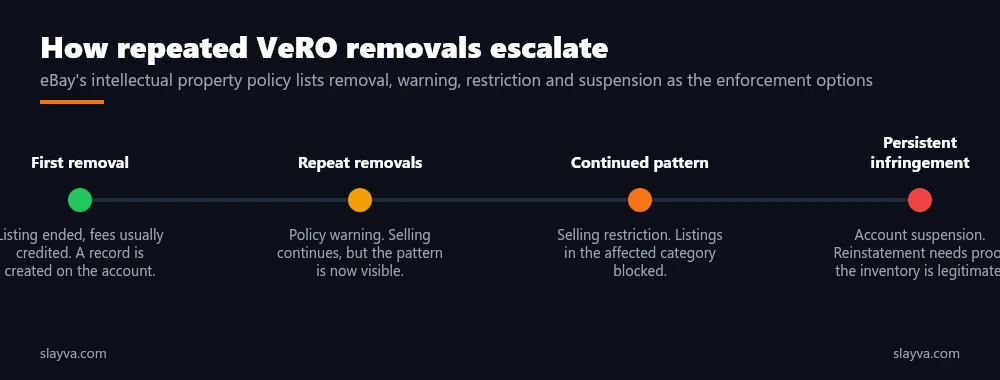
This is why the second step is to stop rather than to argue. An account with three VeRO removals across three different products over two years looks different from an account with three removals of the same product in one week. The first is a seller learning the rules. The second is a seller ignoring them. Sellers scaling toward a thousand listings should treat a VeRO removal as a sourcing signal and audit the rest of the catalogue for the same exposure before it becomes a pattern.
| Stage | What happens | What to do |
|---|---|---|
| First removal | Listing ended, notice sent, record created | Follow the five steps, audit similar listings |
| Repeat removals | Policy warning on the account | Stop the product line, document the sourcing change |
| Continued pattern | Selling restriction, often category specific | Supply proof or exit the category, respond to the restriction notice |
| Persistent infringement | Account suspension | Structured appeal with supplier evidence |
Preventing the Next Notice
Prevention is cheaper than any response, and it is the last part of the response. Before listing a branded item, check whether the brand runs a VeRO participant page and read it. Buy from suppliers who provide invoices with their legal name and address, and keep those invoices organised by product so a request for proof is a five minute task rather than a week of searching.
Photograph your own stock rather than lifting manufacturer images. Write titles that state what the item is and what it works with, in that order. Sellers who source products cheaply from liquidation and wholesale channels should confirm that the goods are lawful to resell in their market, because a low price is sometimes low for a reason. Knowing how to respond is useful. Not needing to is better.
Most VeRO notices are avoidable at the sourcing stage. The removal is the expensive way of learning which supplier you should not have used.
For sellers managing large branded catalogues, a periodic audit of brand item specifics and image sources is part of normal large inventory management. It is also one of the checks our eBay account management services run when we take on an account, because a catalogue with unaddressed exposure is the most common reason a previously clean account receives a cluster of notices at once. See all our eBay seller services.
Frequently Asked Questions About eBay VeRO Notices
Does a VeRO removal affect my seller rating?
Not directly. VeRO removals are policy events, not transaction defects, so they do not appear in the defect rate that sets your seller level. They are recorded on the account and repeated removals lead to warnings and restrictions, which is a separate track from performance standards.
Should I contact eBay or the rights owner first?
The rights owner. eBay acts on the rights owner’s report and is able to reinstate a listing when the rights owner retracts it. Remember that eBay support did not make the claim and is not able to withdraw it on your behalf.
Do I get my listing fees back after a VeRO listing removed notice?
Fees on a VeRO listing removed by eBay are typically credited. Any pending order is cancelled. Check the notice and your account for the credit, and raise it with eBay only if it does not appear within the usual billing cycle.
What if the rights owner never replies?
Wait a reasonable period, then follow up once. Silence from the rights owner is the hardest case. If there is still no response and the item is genuine with documentation, you have a decision to make about relisting, and that decision should weigh the account’s existing history. A second removal on a documented genuine item is a stronger position than a second removal with no proof, but it is still a second removal.
Is a VeRO counter notice a good idea?
Only for copyright claims where you own the removed content and are able to prove it. It is a legal declaration with liability attached. It does not apply to trademark, counterfeit, or design claims, which make up most VeRO activity.
Is relisting the item under a different title an option?
No, and this is the most common misunderstanding of VeRO. Relisting the same item with a changed title to avoid detection is the pattern eBay’s enforcement is designed to catch, and it usually produces a faster second removal plus a warning. If the listing was removed for a fixable reason, fix it and relist once. If the item itself was the problem, retitling does not change that.
How long do VeRO records stay on my account?
eBay does not publish a retention period for VeRO records, so your response today is also a decision about how the account reads in two years. Treat them as permanent for planning purposes, and focus on keeping the pattern clean rather than waiting for old events to expire.
Cluster of VeRO notices on one account?
We audit the catalogue for exposure, handle the rights owner correspondence, and keep the account out of restriction territory. Honest assessment first.
Get an eBay account reviewConclusion
How to respond to an eBay VeRO notice comes down to one reframing: the claim belongs to the rights owner, and so does the resolution. Read the notice, hold the stock, contact the party named, gather the proof that matches the claim type, and give eBay either a retraction or a corrected listing. Use the counter notice only for copyright claims on content you own. Treat every removal as a sourcing signal and audit the catalogue before the pattern forms.
Handled this way, a VeRO response becomes routine and a notice is a contained event rather than the first line of a suspension file. If the pattern has already formed and the account is restricted or suspended, our guide on how to get a suspended eBay account reinstated covers the next stage, and more eBay policy guides are in the blog library.

Usman Malik
All posts by Usman MalikNeed this handled for you?
eBay Policy Violation Recovery
VeRO, policy warnings and removed listings resolved.
See the serviceeBay Account Management
Listings, orders, cases and growth, run for you.
See the service- Have this problem now? eBay policy violation
- Have this problem now? eBay account suspended (MC999)
- Have this problem now? eBay sales dropped