eBay Buyer Protection: What Sellers Must Know in 2026
- Updated
- eBay, eBay Policies & Seller Protection
- 13 min read

Table of contents
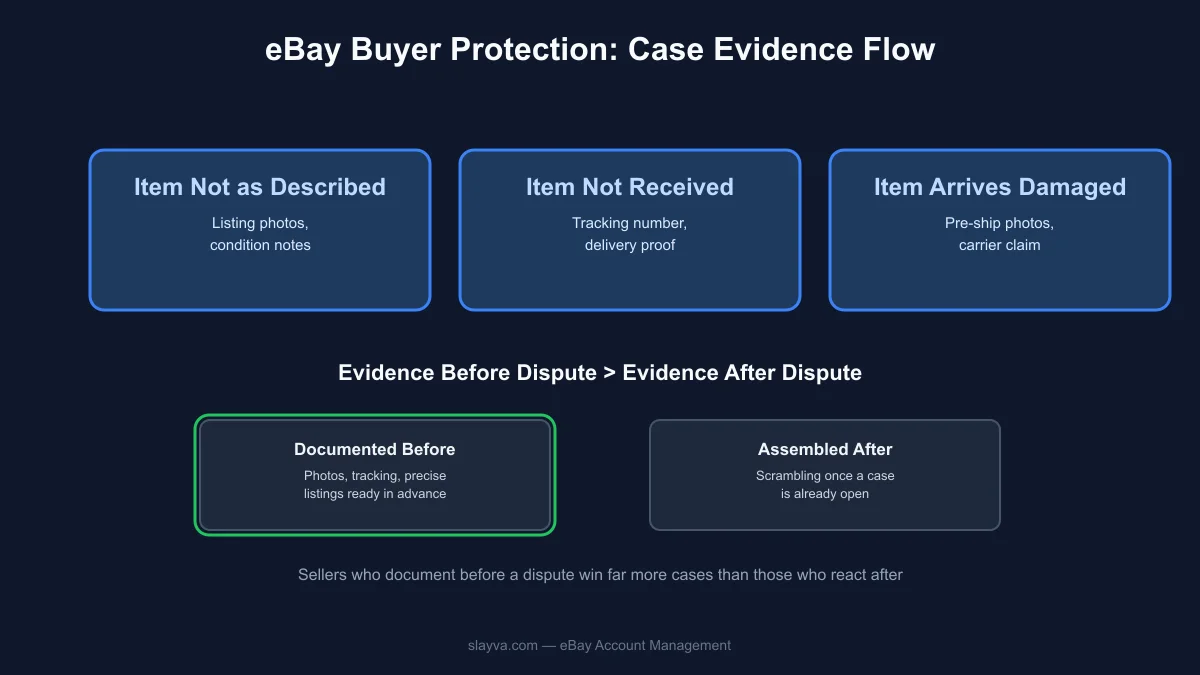
Ask most sellers about eBay buyer protection and you’ll get the same reaction: a program built entirely to favor buyers, with sellers left picking up the cost. That reputation isn’t fully deserved. It is an evidence-based system, and sellers who understand exactly how it works, and document accordingly, win a meaningful share of the cases that reach it.
This guide walks through what the program actually covers, how cases get decided, the specific evidence that turns a losing dispute into a winning one, and the listing and packaging habits that keep the number of disputes you face low in the first place. If you’re dealing with a case right now, or just want your store to hold up better the next time one arrives, understanding how the system actually functions changes how confidently you can respond when it does.
Key Takeaways
- Buyer protection cases are decided on submitted evidence, not automatically in the buyer’s favor.
- Documentation gathered before a dispute, photos, tracking, accurate listings, carries far more weight than anything assembled after a case opens.
- A pattern of lost disputes affects seller performance metrics, which is why understanding the system matters beyond any single case.
What eBay Buyer Protection Actually Covers
Formally called the eBay Money Back Guarantee, it allows a buyer to open a case when an item doesn’t arrive, arrives significantly different from its description, or arrives damaged. Once a case opens, it moves through the Resolution Center, where both parties can submit evidence before a decision, either negotiated directly between buyer and seller, or issued by eBay if the two sides can’t agree.
The framing that the program is a rubber stamp for buyers misses how the system is actually built. eBay’s own guidelines direct case reviewers to weigh documentation on both sides. Sellers without any evidence to submit tend to lose by default, not because the system is biased, but because there’s nothing on their side of the ledger to weigh.
The Deadlines That Decide Most Cases
Many lost cases come down to a missed deadline rather than weak evidence. These timeframes are from eBay’s Money Back Guarantee policy for eBay.com:
- A buyer can report an item not received once the estimated or actual delivery date has passed, and up to 30 calendar days after it.
- A buyer can request a not-as-described return within 30 calendar days of delivery, or within your stated returns window if that is longer.
- You have 3 business days to respond to a not-received report or a return request, with tracking, a delivery update or a refund.
- Once a return arrives, refund within 2 business days, unless the return details show a longer deadline.
- If it isn’t resolved, the buyer can ask eBay to step in: for a not-received report, from 3 to 21 business days after reporting it. eBay may step in without being asked when there’s no valid tracking.
- Either side can appeal eBay’s decision within 30 calendar days.
The Three Categories of Buyer Protection Cases
Item Not as Described
This is the most common case type sellers face, and also the most winnable when the original listing was accurate. The defense here lives entirely in what the listing said and showed at the time of sale, condition notes, photos, and dimensions all matter.
Item Not Received
Tracking decides almost everything in this category. eBay’s policy sets the proof it accepts: a carrier tracking number uploaded to eBay, showing a shipping scan before the latest estimated delivery date and a status of delivered or attempted delivery, with the delivery date and a ZIP code or city that matches the buyer’s address. Orders of $750 or more also need signature confirmation. With that proof in place, the case is usually decided on it, whatever the buyer claims separately.
Item Arrives Damaged
eBay treats damage under its not-as-described rules, usually through a return. Packaging evidence is the key variable: photos of how an item was packed before shipment, plus a carrier claim reference where applicable, show the item left you in the condition described.
Every case decision, in either direction, becomes part of a larger performance picture over time, which is exactly why the habits covered in this guide matter beyond any single dispute you’re currently facing.
Buyer Protection vs. Seller Protection: How the Two Work Together
Sellers often assume buyer protection exists in opposition to their own interests, but eBay actually runs a parallel set of seller protections alongside it. Seller-side protections cover things like unauthorized account access, certain fraudulent buyer behavior, and cases where a buyer’s claim contradicts eBay’s own tracking or payment records.
Understanding that buyer protection and seller protection are two halves of the same trust system, rather than one program stacked against the other, changes how you should approach a case: the goal isn’t to fight the buyer protection framework, it’s to work correctly within it using the seller-side protections you’re also entitled to.
Three Typical Cases
These are illustrations of common patterns, not real client cases.
Case one, a winnable dispute. A buyer opens an item-not-as-described case claiming a jacket was “heavily worn,” despite the listing clearly stating “pre-owned, visible wear on cuffs” with matching photos. The seller submits the original listing screenshots as evidence. eBay’s review sides with the seller because the listing accurately disclosed the condition being disputed.
Case two, a lost dispute that shouldn’t have been. A seller ships an item without tracking to save on postage. The buyer claims non-receipt. Without tracking, the seller has no evidence to submit, and the case defaults against them, not because the buyer was necessarily right, but because there was nothing to weigh against the claim.
Case three, a case worth escalating. A buyer requests a full refund citing “item not as described,” but the actual message thread reveals a simple change of mind. The seller submits the message history alongside the accurate original listing. eBay’s review recognizes the mismatch between the stated reason and the real one, and the case resolves in the seller’s favor.
Building a Case That Actually Wins
| Case Type | Evidence to Submit | Why It Works |
|---|---|---|
| Item Not as Described | Original listing photos, exact wording, condition notes | Confirms the item matched what was promised |
| Item Not Received | Tracking number, delivery confirmation, carrier proof | Confirms the fulfillment obligation was met |
| Item Damaged in Transit | Pre-shipment packaging photos, carrier claim reference | Shifts responsibility toward shipping, not the seller |
| Buyer’s Remorse Disguised as a Claim | Message history, listing return terms | Exposes a mismatch between the stated issue and the real one |
Across every row in that table, the same pattern holds: documentation created before a dispute starts is worth far more than anything gathered after the fact. Sellers who photograph every item before it ships, and keep listing language precise, are simply working from a stronger position the moment a case is opened against them.
What to Do the Moment a Case Opens
- Stay factual in every message. Emotional or defensive responses are read by both the buyer and, if it escalates, by eBay’s review team, keep the tone solution-focused regardless of how the claim feels.
- Pull your evidence immediately. Don’t wait for the response deadline to approach; gather tracking, photos, and listing details the same day the case opens.
- Submit through the Resolution Center, not just as a reply to a buyer message, formal evidence needs to live where eBay’s reviewers actually look.
- Offer a fair resolution when the claim has merit. Not every case deserves a fight, a genuine issue resolved quickly protects your account health more than a contested case you’re likely to lose anyway.
- Escalate clearly false claims to eBay directly, with your documentation attached, rather than continuing to negotiate with a buyer who isn’t engaging honestly.
How Buyer Protection Cases Affect Your Seller Account
A single lost dispute rarely does lasting damage. A pattern of them is a different story, cases resolved against a seller typically count toward defect rate, and a rising defect rate is one of the fastest routes to a performance-based notice on your account. If you’re seeing that pattern emerge, it’s worth reading how to handle an eBay account warning before the situation escalates any further.
Return policy and dispute volume are closely linked. A clear, fair return policy resolves many issues before they ever become a formal case, our guide to handling eBay returns profitably covers exactly how to structure one that protects margin without inviting disputes.
Common Mistakes Sellers Make With Disputed Cases
The most frequent mistake is not photographing items before shipment at all, without that record, a damage claim is essentially unwinnable regardless of what actually happened. The second is refunding automatically to avoid conflict, even on claims worth contesting, which trains buyers (and, over time, the platform’s own risk signals) to expect an easy win.
The third is arguing in message threads instead of formally submitting evidence through the Resolution Center, which means the strongest points never actually reach the people deciding the case. The fourth is missing the response window entirely, which almost always defaults the case against the seller regardless of the underlying facts.
Listing Habits That Reduce Dispute Risk Before You Ever List
Small changes at the listing stage compound into a measurably lower dispute rate over time. Use every available photo slot rather than the minimum, additional angles, close-ups of any flaws, and a photo showing scale all reduce the chance a buyer feels misled later. Write condition notes in plain, specific language rather than vague grading terms; “small scuff on the left heel, pictured” holds up far better under an eBay review than “good condition” alone.
Fill in every relevant item specific field, since buyers filtering by size, material, or model are implicitly agreeing to those exact specifics at checkout, which narrows the room for a later dispute. Finally, state your handling time and shipping method clearly in the listing itself, not just in your account-wide policies, buyers who see an accurate expectation up front are simply less likely to open an item-not-received case out of impatience.
Preventing Disputes Before They Start
The lowest-effort way to win more cases is to generate fewer of them. Precise listings with accurate condition notes reduce item-not-as-described claims dramatically, a small amount of extra detail at listing time saves far more time later. Reliable tracking on every shipment closes off item-not-received claims almost entirely. Careful packaging, documented with a quick photo before sealing, protects against damage claims without adding meaningful time to your fulfillment process.
If managing dispute prevention and case response across a full catalog is more than you can track manually, our eBay account management service includes ongoing case handling and defect-rate monitoring as part of full account management. See all our eBay seller services.
How Category Affects Your Exposure
Not every category carries the same dispute risk. Apparel and shoes tend to draw fit-related not-as-described claims, so detailed measurements in the listing, not just size labels, help. Electronics are more exposed to not-received and damage claims because of their value and fragility, which makes tracking and padded packaging especially important.
Collectibles and vintage items see more condition disputes, where third-party grading references or highly specific condition photography make the biggest difference in how a case resolves. Tailoring your documentation habits to your actual category’s risk profile, rather than applying one generic approach, meaningfully changes how often cases go your way.
What Happens After a Case Is Decided
Once a case is decided, the outcome affects more than that order. A case closed in the buyer’s favour without you resolving it counts against your seller performance; one closed in your favour has no further impact. eBay’s policy lets either side appeal a decision within 30 calendar days, and an appeal is worth making when you have something new to add, such as a tracking update that posted late or a buyer message that contradicts the claim.
An appeal is a second chance, not a substitute for good records. The habits covered earlier, tracking, photos and precise listings, matter more before a case opens than any argument made after it.
When a Case Escalates Beyond the Resolution Center
Most cases resolve within the standard Resolution Center flow, but a small share escalate further, typically when a buyer isn’t satisfied with the initial outcome, or when eBay itself flags a case for manual review due to conflicting evidence. At this stage, response quality matters even more than at the first submission.
Provide a clear timeline of the transaction rather than repeating your original evidence verbatim, since a reviewer seeing the case fresh benefits from context, not just documents. Reference specific policy sections where relevant rather than general fairness arguments, eBay’s escalation reviewers respond to policy-grounded submissions more consistently than emotional appeals.
And if the case involves a high-value item, consider requesting a phone or chat conversation with eBay support directly rather than relying solely on written Resolution Center messages, since complex cases often benefit from a reviewer who can ask clarifying questions in real time. Sellers who treat an escalated case as a fresh, well-organized submission, rather than a frustrated repeat of the same message, see meaningfully better outcomes at this stage.
Building Buyer Trust to Reduce Disputes Overall
Beyond documentation and evidence, a small amount of proactive buyer communication reduces disputes before they ever reach eBay. A brief message after shipment, confirming tracking and expected delivery, closes off a large share of item-not-received anxiety before it turns into a formal case. Clear, honest photos at listing time build the same trust in the other direction, since buyers who feel fully informed before purchase are simply less likely to feel misled afterward. None of this replaces the documentation habits covered earlier, it works alongside them, reducing how often you need to rely on evidence in the first place.
A Few Terms Worth Knowing
Resolution Center is where formal buyer protection cases live and get decided, separate from regular buyer-seller messages.
Defect rate tracks the percentage of your transactions involving a case, late shipment, or cancellation. Lost disputes count against it directly.
INR is shorthand for “item not received”, one of the three core case types covered above.
SNAD is shorthand for “significantly not as described”, the formal term behind most item-not-as-described claims.
Knowing this shorthand helps when reading eBay’s own help documentation or discussing a case with support, since these terms show up constantly in official guidance.
Frequently Asked Questions
Can sellers actually win these disputes? Yes, cases backed by clear tracking, accurate listings, and pre-shipment photos are won by sellers regularly. The idea that the system always favors buyers mainly comes from sellers who had no documentation to submit.
Does losing a case hurt my account? Yes, cases resolved against the seller typically count toward defect rate, which affects seller level and, in volume, can trigger a performance review.
Should I just refund instead of contesting every case? For clearly valid claims, yes. For claims your documentation contradicts, submitting evidence is almost always worth the few minutes it takes.
How long do I have to respond once a case opens? Three business days for a not-received report or a return request, under eBay’s Money Back Guarantee policy. After a return arrives, you have 2 business days to refund unless the return details show a longer deadline.
Is the outcome ever automatic in the seller’s favor? No case is automatic in either direction. Every outcome is evidence-dependent, which is exactly why documentation habits matter more than the specific policy wording.
What’s the single most useful habit for winning more cases? Photographing every item immediately before shipment. It’s the one piece of evidence that resolves the largest share of disputes almost instantly.
Does eBay penalize sellers for opening too many appeals? No, but appeals without supporting evidence are simply unlikely to succeed, the volume of appeals isn’t the issue, the quality of evidence behind each one is.
Does a business account get different treatment under buyer protection than a personal account? The evidentiary standard is the same for both, but business accounts often have more established selling history and tracking discipline, which in practice correlates with stronger case outcomes, the account type itself isn’t the deciding factor, consistent documentation is.
Does eBay buyer protection cover digital or intangible goods? Generally no, the program is built around physical item delivery and condition, so digital goods, services, and certain intangible listings fall outside its standard scope and are handled through other policies.
Conclusion
Buyer protection isn’t the seller-hostile system its reputation suggests, it’s an evidence-based process that rewards sellers who document consistently. Photograph before you ship, keep listings precise, respond to cases quickly and factually, and you’ll win the disputes that deserve to be won. If disputes are already affecting your account’s standing, get a free audit and we’ll show you exactly where the risk is coming from, how to close the gap, and how to keep your defect rate clean going forward.
More Questions About Buyer Protection
How eBay Buyer Protection Works
It works by giving both sides a window to submit evidence before a case is decided, either through direct negotiation or an eBay-issued ruling. Sellers who understand this process treat every case as evidence-based rather than automatically lost.
eBay Seller Protection Policy Tips
A few practical seller protection policy tips make a real difference: always ship with tracking, keep listing photos and condition notes accurate, and respond to every case within the stated window. These habits work alongside buyer protection rather than against it.
Handling an eBay Item Not as Described Case
An item not as described case is won or lost almost entirely on how closely the original listing matched what shipped. Pulling the exact listing text and photos as evidence is the single most effective response once this type of case opens.
How to Appeal a Case Decision
If a decision seems wrong, appeal within 30 calendar days of it, and add something concrete rather than repeating the original argument: a tracking update, a message thread, or documentation that wasn’t part of the first submission.

Mubshar
All posts by MubsharNeed this handled for you?
eBay Policy Violation Recovery
VeRO, policy warnings and removed listings resolved.
See the serviceeBay Account Management
Listings, orders, cases and growth, run for you.
See the service- Have this problem now? eBay policy violation
- Have this problem now? eBay account suspended (MC999)
- Have this problem now? eBay sales dropped