

Introduction
Returns are an inevitable part of selling on eBay. The difference between a seller who dreads return requests and one who handles them profitably often comes down to understanding the eBay returns policy for sellers and responding strategically. According to the National Retail Federation, approximately 19.3% of online sales were returned in 2025, making returns a normal part of ecommerce rather than a sign of failure.
Smart sellers do not try to avoid returns entirely. Instead, they handle each one quickly, by the rules, and with a cool head. This guide covers everything you need to know about the eBay returns policy for sellers, including how to handle eBay returns as a seller, practical tips to reduce returns, and how to protect yourself from buyer abuse. By the end, you will have a clear strategy for turning returns from a profit drain into a manageable part of your business operations.
Key Takeaways
- eBay returns are split into two types: remorse returns and not-as-described (SNAD) returns, each with different rules
- You have 3 business days to respond to a return request before eBay can step in
- Top Rated Sellers and those offering free returns can deduct up to 50% from refunds when items come back used or damaged
- Accurate listings and high-quality photos are your first line of defense against returns
- eBay’s abusive buyer policy protects sellers from buyers who misuse returns, feedback, or dispute processes
- Partial refunds can often save you money compared to paying return shipping both ways
- Analyzing return patterns helps you identify and fix recurring issues
Understanding the eBay Returns Policy for Sellers
The eBay returns policy for sellers is not a one-size-fits-all rule. It depends on several factors: your stated return policy, the reason the buyer gives for the return, and your seller status. Before you can handle returns effectively, you need to understand how the system works.
Types of Returns: Remorse vs. Not as Described
eBay returns fall into two distinct categories, and the difference determines what you are obliged to do and who pays for shipping.
Remorse returns occur when a buyer changes their mind, orders by mistake, or decides the item does not fit. Your stated eBay returns policy for sellers decides whether you accept these returns. If you offer 30-day returns, you accept them. Who pays return shipping depends on your policy – the buyer pays unless you offer free returns.
Not-as-described returns (SNAD) occur when the item is damaged, faulty, incorrect, or does not match your listing. You must accept these even if your policy says no returns, and you always pay the return shipping. There is no way around this requirement under the eBay Money Back Guarantee.
The 3-Business-Day Response Window
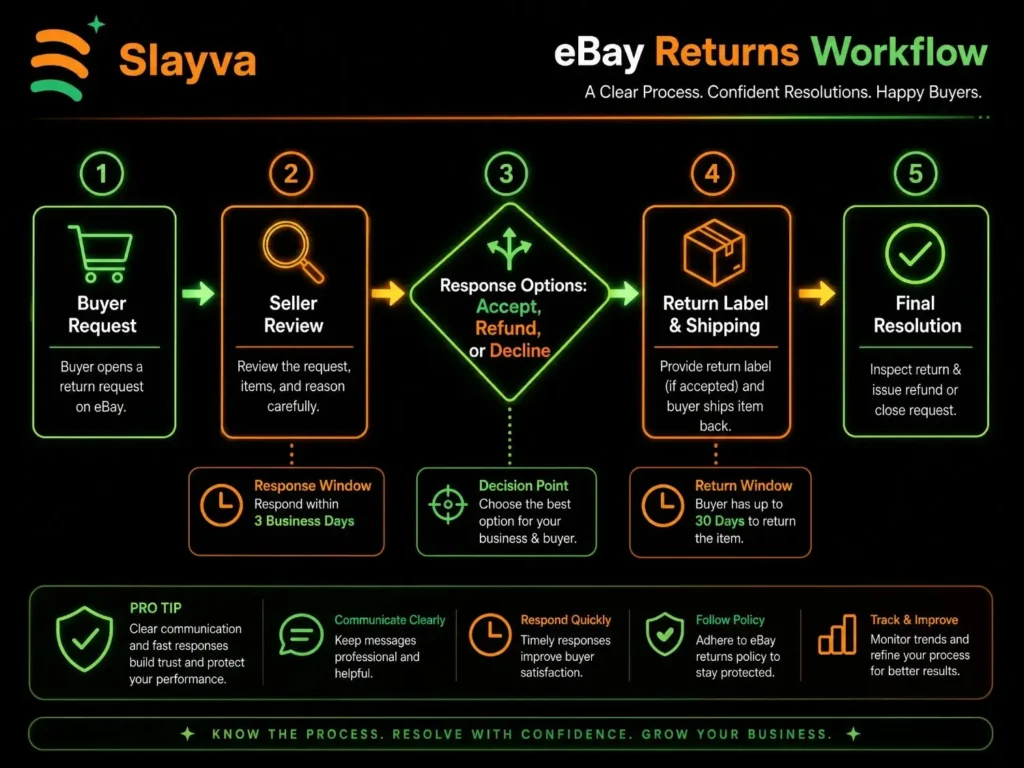
When a buyer opens a return request, you have 3 business days to respond. During this window, you can:
- Accept the return and send a shipping label
- Offer a full refund and let the buyer keep the item
- Offer a partial refund and let them keep it
- Offer a replacement or exchange
- Message the buyer to ask a question
- Decline the return (for remorse returns under a genuine no-returns policy)
If you do not respond within 3 business days, either side can ask eBay to step in. Once you agree to refund or get the item back, you have 2 business days to pay, or eBay will refund for you. Every case closed without your resolution becomes a defect, so the goal is always to resolve it yourself, on time.
Return Shipping: Who Pays?
Under the eBay returns policy for sellers, who pays for return shipping depends on the return type:
| Return Type | Who Pays Return Shipping |
|---|---|
| Remorse (buyer changed mind) | Buyer pays, unless you offer free returns |
| Not as described (SNAD) | The seller always pays |
Seller Protections Under the eBay Returns Policy
eBay offers important protections for sellers who follow the rules. If eBay finds a buyer’s behavior abusive, they will take action on the buyer and remove negative feedback and defects, including opened cases in service metrics.
eBay also protects sellers from events outside their control, such as weather or carrier delays, by removing negative feedback and defects. Seller Protection covers eBay sellers in the event of claims and reversals resulting from unauthorized payments or lost items, and guards against abusive buying behavior.
How to Handle eBay Returns as a Seller
Knowing how to handle eBay returns as a seller is essential for protecting your metrics and maintaining profitability. The way you respond to a return request can mean the difference between a smooth resolution and a costly defect.
Identify the Return Type
The first thing to work out is which kind of return it is. Check the reason the buyer selected:
- “Changed my mind” or “Ordered by mistake” = remorse return
- “Doesn’t match description” or “Damaged” = SNAD return
This decision determines your obligations and who pays for shipping.
Choose Your Response Strategy
Once you know the type, you have several options:
Accept the return and send a label – This is the standard approach for most returns. For remorse returns, the buyer pays shipping unless you offer free returns. For SNAD returns, you pay.
Offer a full refund and let the buyer keep the item – Sometimes the cost of return shipping exceeds the item’s value. In these cases, refunding without requiring the item back can save you money.
Offer a partial refund – Partial refunds are an underused tool. If a buyer is mostly happy but the item arrived with a minor flaw, a small partial refund where they keep the item often costs far less than paying shipping both ways. This is a key skill in learning how to handle eBay returns as a seller profitably.
Offer a replacement or exchange – For items where you have inventory, offering a replacement can satisfy the buyer while keeping the sale.
Message the buyer – Sometimes a simple conversation resolves the issue. The buyer may have made a mistake or may be willing to accept a solution that does not involve a return.
Process the Refund Promptly
Once you receive the returned item, you have 3 business days to inspect it and issue the refund. If the item comes back used or damaged, you may qualify to deduct from the refund.
Handle Disputes Professionally
If a buyer escalates a case to eBay, respond promptly with evidence. To be eligible for Seller Protection, you must respond to the eBay dispute and act within the required time frames, providing any evidence required by eBay on time. You must also comply with eBay’s User Agreement.
Expert tip: When you have no proof to dispute with, refund fast. Fight only when the evidence is on your side. Every case closed without your resolution becomes a defect.
eBay Seller Return Policy Tips for 2026
Implementing effective eBay seller return policy tips can significantly reduce your return rate and protect your profits. Here are proven strategies to implement today.
Offer Clear, Accurate Listings
The most effective way to reduce returns is to ensure buyers know exactly what they are getting. “What you see is what you get” remains the fundamental expectation of online shoppers.
eBay seller return policy tips for listings:
- Use bullet-pointed key specifications for easy scanning
- Prominently display critical details like brand, dimensions, color, and model
- Include comprehensive information about materials, features, and usage
- Include product identifiers like UPC or ISBN when available
- Honestly disclose any flaws or imperfections
Invest in Quality Product Photography
Visuals are your most powerful sales tool and your best defense against “not as described” returns.
eBay seller return policy tips for photography:
- Use crisp, well-lit images showing true product colors
- Include multiple angles for complete visualization
- Provide size references by photographing items alongside common objects
- Highlight unique features with close-up shots
- Clearly photograph any existing flaws
- Avoid generic stock photos in favor of original images
Implement Robust Packaging Protocols
Even perfect products become returns if they arrive damaged.
eBay seller return policy tips for packaging:
- Select appropriate materials like bubble wrap, foam inserts, and sturdy boxes
- Fill all empty spaces with cushioning materials
- Reinforce boxes with ample tape on seams and edges
- Apply “Fragile” warning labels when appropriate
Analyze Return Patterns
Data-driven insights help you refine your operations and prevent future returns.
eBay seller return policy tips for analysis:
- Document reasons for each return
- Identify frequently returned items and common issues
- Enhance descriptions based on buyer feedback
- Adjust packaging methods for fragile items
- Address quality concerns with suppliers
Offer Competitive Return Policies
Buyer-friendly policies build confidence and can qualify you for eBay seller discounts.
eBay seller return policy tips for policies:
- Provide a minimum 30-day return window
- Streamline the return process
- Cover return shipping for seller-caused issues
Common mistake: Assuming a strict no-returns policy will protect you. Under the eBay Money Back Guarantee, buyers can still return an item if it arrives damaged, faulty, wrong, or not as described. Your return policy is not a shield against every return.
How to Reduce eBay Returns in 2026
Proactive sellers can implement effective strategies to minimize returns while improving operational efficiency. Here is how to reduce eBay returns in 2026.
Address Root Causes of Returns
Before implementing solutions, understand the primary drivers of returns:
- Inaccurate product descriptions – Discrepancies between listed and received items regarding color, size, or functionality frequently prompt returns
- Quality issues – Defective, damaged, or substandard products naturally lead to buyer dissatisfaction
- Shipping damage – Improper packaging often results in products arriving damaged during transit
- Delivery delays – Modern consumers expect prompt shipping, and delays frequently trigger cancellations or returns
- Unclear return policies – Overly restrictive or confusing policies may discourage purchases altogether
Implement Quality Control Measures
In 2026, eBay sellers should improve the control between the listing promise and the current shipment. Quality control improves when listing accuracy, product file evidence, inspection proof, packing checks, service metrics, and return data feed the next shipment decision.
Common quality control mistakes to avoid:
- Selling unverified supplier goods
- Using photos that no longer match the shipment
- Ignoring packaging and accessory checks
- Missing product safety requirements
- Failing to inspect before bulk shipment
- Not tracking defects that cause item-not-as-described returns
Use Return Data to Improve
Each return contains valuable information. Document the reason, identify patterns, and adjust your listings and processes accordingly. If you consistently receive returns for sizing issues, add more detailed size charts. If items arrive damaged, improve your packaging.
Expert tip: Honest details reduce returns and negative feedback. Transparency about flaws, measurements, and condition sets clear expectations and reduces surprises.
eBay Buyer Returns Abuse Protection
One of the most frustrating aspects of selling on eBay is dealing with buyers who abuse the returns system. Fortunately, eBay has robust eBay buyer returns abuse protection measures in place.
Understanding eBay’s Abusive Buyer Policy
eBay’s abusive buyer policy lays out unacceptable buying behavior. Buyers may not misuse feedback, returns, buyer protection programs, or payment dispute processes. When buyers do not meet these standards, sellers can report abusive behavior.
Behaviors eBay does not allow:
- Demanding something not offered in the original listing
- Requesting a partial refund without returning the item
- Requesting additional items or services not included in the original listing
- Misusing returns or making false claims
How eBay Protects Sellers
eBay has implemented stronger measures against buyers who do not follow the abusive buyer policy. These include:
- Proactively finding abusive buyers and preventing them from filing return requests
- Suspending buyers in serious cases
- Removing any feedback and defects, including open cases in service metrics
- Limiting abusive buyers’ ability to request returns on eBay
When eBay determines a buyer has violated the abusive buyer policy, it will remove any related negative or neutral feedback and bad transaction records, including open cases in service metrics.
Deducting from Refunds for Used or Damaged Returns
If an item is returned in a different condition than it was originally sent, eligible sellers can deduct from the refund to recover the lost value.
Key rules for deductions:
- You can deduct up to 50% from the refund
- Top Rated Sellers and sellers who offer free returns can deduct up to 50% when an item comes back in a different condition
- You must report the buyer and send the refund within 3 business days after receiving the item back
- If you deduct from the refund, eBay will work directly with the buyer on any issues
- The return will not count in your “Item not as described” rate in service metrics
If an item is returned with significant damage or the wrong item is returned, eBay may be able to help.
How to Report Abusive Buyers
You can report a buyer to eBay by selecting the report button in Seller Hub. When you report a buyer, you can more clearly describe what the buyer is doing to help eBay investigate potential policy violations and take actions to protect you.
When to report a buyer:
- Buyer demanded something that was not offered in your listing
- Buyer made a false claim
- Buyer misused returns
- Buyer repeatedly makes and then retracts bids
Blocking Problem Buyers
You have control over who can bid on and buy your items. If you have had an issue with a buyer, you can add them to your blocked buyers list. Blocked buyers cannot purchase from you until you remove them from your list.
Expert tip: If a buyer is making demands that are not a part of your original listing, you will be protected from negative feedback and defects when you either deliver the item according to the original terms of your listing or cancel the transaction.
Comparison Table: Return Types and Seller Obligations
| Return Type | Must Accept? | Who Pays Shipping? | Can You Deduct? |
|---|---|---|---|
| Remorse (buyer changed mind) | Only if your policy allows | Buyer pays (unless you offer free returns) | No |
| Not as described (SNAD) | Yes, always | The seller always pays | Yes, if the item is returned used/damaged (up to 50%) |
| Item damaged in shipping | Yes | Seller pays | Yes, if you have evidence of proper packaging |
| Wrong item sent | Yes | Seller pays | No, unless buyer used the wrong item |
Frequently Asked Questions
What is the eBay returns policy for sellers in 2026?
The eBay returns policy for sellers requires you to accept returns for items that are not as described, damaged, faulty, or wrong. For remorse returns, you only accept them if your stated policy allows. You have 3 business days to respond to any return request. Learn more about the eBay returns policy.
How do I handle eBay returns as a seller?
To handle eBay returns as a seller, first identify the return type (remorse or SNAD). Then choose your response: accept the return, offer a full or partial refund, offer a replacement, or message the buyer. Respond within 3 business days and process refunds within 2 business days after receiving the item back.
Can I refuse a return on eBay?
You can refuse remorse returns if your policy states no returns. However, you cannot refuse returns for items that are not as described, damaged, faulty, or wrong. These are covered under the eBay Money Back Guarantee.
How can I reduce eBay returns in 2026?
To reduce eBay returns in 2026, create accurate, detailed product descriptions, invest in high-quality product photography, implement robust packaging protocols, offer fast trackable shipping, and analyze return patterns to identify recurring issues.
What is eBay buyer returns abuse protection?
eBay buyer returns abuse protection includes measures to identify and take action against abusive buyers. When eBay finds a buyer has violated the abusive buyer policy, they remove feedback and defects, limit the buyer’s ability to request returns, and may suspend their account.
Can I deduct from a refund if a buyer returns a used item?
Yes, if an item is returned in a different condition than it was originally sent, eligible sellers can deduct up to 50% from the refund to recover the lost value. Top Rated Sellers and those offering free returns qualify for this protection.
How do I report an abusive buyer on eBay?
You can report an abusive buyer through Seller Hub using the report button. Report buyers who demand something not offered in your listing, make false claims, misuse returns, or repeatedly make and retract bids.
Does eBay offer seller protection for returns?
Yes, eBay offers seller protection for returns. If eBay finds a buyer’s behavior abusive, they will remove negative feedback and defects. Seller Protection also covers unauthorized payments, lost items, and events outside your control.
Should I offer free returns on eBay?
Offering free returns can increase buyer confidence and qualify you for Top Rated Seller status. It also makes you eligible for enhanced seller protections, including the ability to deduct up to 50% from refunds when items come back used or damaged.
What happens if I don’t respond to a return request?
If you do not respond to a return request within 3 business days, the buyer can ask eBay to step in. Cases closed without your resolution become defects on your account and can impact your seller performance metrics.
Can I offer a partial refund instead of accepting a return?
Yes, offering a partial refund is often a smart strategy. If a buyer is mostly happy but the item has a minor flaw, a partial refund where they keep the item often costs far less than paying shipping both ways.
What should I do if a buyer returns a different item?
If a buyer returns the wrong item or an item with significant damage, you may be able to get help from eBay. Report the buyer and follow the return dispute process. You may qualify for seller protections in these cases.
Final Thoughts
Mastering the eBay returns policy for sellers is essential for building a profitable and sustainable eBay business. Returns are not a sign of failure – they are simply part of selling online. The sellers who protect their metrics are not the ones who avoid returns. They are the ones who handle each one fast, by the rules, and with a cool head.
Start by understanding the difference between remorse and not-as-described returns, and know your obligations for each. Respond to every return request within 3 business days. Use partial refunds strategically to save money on shipping costs. Invest in accurate listings and quality photos to prevent returns before they happen. And when buyers abuse the system, report them and use eBay’s seller protections to defend your business.
Implement these eBay seller return policy tips today. Your profitability depends on it.
Ready to Automate Your eBay Growth?
Managing strict return policies, handling buyer disputes, and tweaking listings for the algorithm can easily derail your focus. Let our professional team handle the daily operational grind while you scale your inventory and profits.
Already facing restrictions? Restore your account here .