
Best Time to List on eBay: 7 Proven Strategies to Maximize Sales in 2026
- Updated
- eBay, eBay Selling Tips
- 14 min read

Table of contents
You put hours into sourcing, photographing, and writing your eBay listing, and it still gets buried. The problem often has nothing to do with your product or price. It has everything to do with when you hit publish.
Knowing the best time to list on eBay is one of the most overlooked levers in a seller’s toolkit. Most sellers list whenever it’s convenient for them. That decision hands visibility to competitors who publish at the exact moment buyers are actively searching. eBay’s algorithm rewards fresh listings with a temporary visibility boost, and if that window lands during off-peak hours, you’ve wasted it entirely.
This article breaks down the best listing times by day, hour, and category, so every listing you publish gets the maximum exposure it deserves.
KEY TAKEAWAYS
- For consumer goods, the strongest window is Sunday evening between 6 PM and 10 PM ET
- eBay gives new listings a temporary search visibility boost within the first 2 to 4 hours of going live
- Auction-style listings should end during peak hours, not just start during them
- Category matters: electronics and collectibles spike on weekends, while B2B and industrial items perform better on weekday mornings
- eBay’s built-in listing scheduler lets you publish at peak times without staying up late
- Staggering your listings 15 to 30 minutes apart outperforms bulk-uploading everything at once
What Is eBay Listing Timing and Why Does It Matter
Listing at the right time means publishing your listings at specific days and times that align with peak buyer activity. It is not a random choice. It is a calculated decision based on when your target buyers are most likely to be browsing, searching, and purchasing on the platform.
eBay operates as a search-driven marketplace powered by its Cassini algorithm. When you publish a new listing, Cassini gives it a short-lived freshness boost, temporarily ranking it higher in search results. If that boost lands when buyers are active, your listing gets seen immediately. If it lands at 3 AM on a Tuesday, that boost disappears without generating a single impression.
For auction listings, timing carries even more weight. The end time of your auction determines how many active bidders are watching when the final minutes tick down. According to eBay’s official listing best practices, a poorly timed auction ending can significantly reduce your final sale price simply because buyers were not online to compete.
How eBay’s Cassini Search Engine Treats Listing Time
Understanding listing time starts with understanding how Cassini works. Cassini is eBay’s internal search engine, and it evaluates every listing based on relevance, seller performance, and early engagement signals.
When you publish a listing, Cassini gives it elevated placement in search results for roughly 2 to 4 hours. During this freshness window, your new listing competes with established listings that have been active for days or weeks. That temporary advantage only produces results if buyers are actively searching during that exact window.
Cassini also tracks click-through rate and conversion rate in the early hours after a listing goes live. A listing that earns early clicks and a quick sale signals to Cassini that it is relevant and popular. That signal compounds over time, rewarding the listing with sustained higher placement well beyond the initial freshness window. You can read more about how ranking factors work on the eBay Seller Center search visibility page.
Publishing at 9 AM means your freshness window runs during work hours when most buyers are not browsing. Publishing at 7 PM means your freshness window runs through the heaviest buyer traffic of the entire day. The listing content is identical. The result is not.
Best Time to List on eBay by Day of the Week
eBay has over 132 million active buyers globally, according to eBay’s official investor relations data. Those buyers are not spread evenly across every hour or day. Traffic surges at predictable times, and sellers who time their listings consistently outperform those who publish on a random schedule.
Sunday: The Strongest Day for Consumer Goods
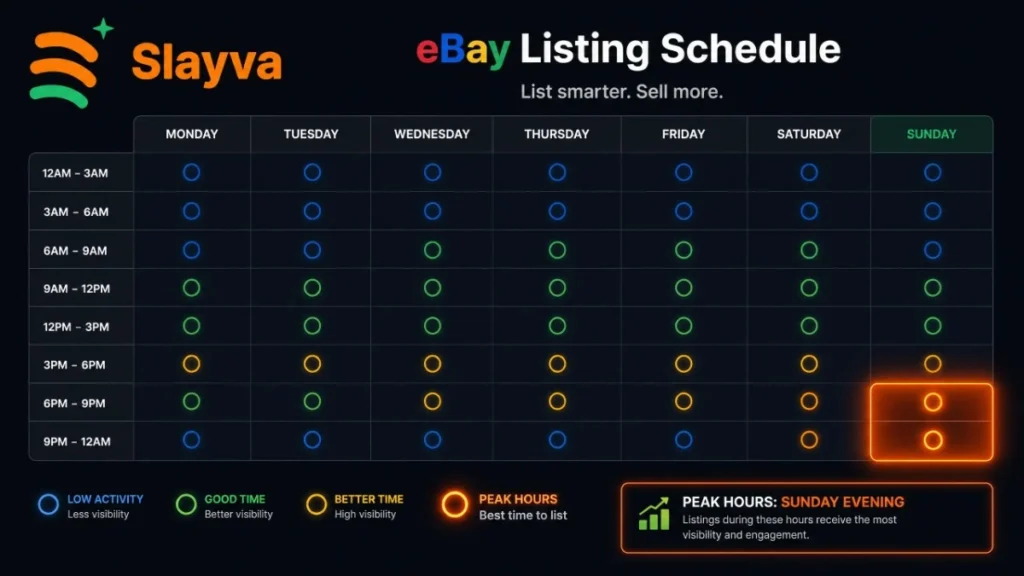
Sunday is the single most valuable day to publish eBay listings for consumer goods. Buyers have time to browse, compare, and purchase without the pressure of a workday schedule. Sunday evening between 6 PM and 10 PM Eastern Time is the window with the widest possible audience reach.
This window captures three overlapping buyer groups simultaneously:
- East Coast buyers winding down their weekend
- Central and Mountain time zone buyers in their early evening
- West Coast buyers finishing their afternoon
If your auction runs for 7 days and you want it to end on Sunday at 8 PM ET, start it the previous Sunday at 8 PM ET. Always plan backwards from your ideal end time.
Thursday and Friday: Strong Secondary Days
For Buy It Now fixed-price listings, Thursday and Friday evenings produce strong results. Buyers often begin thinking about weekend purchases mid-week. A listing published on Thursday between 6 PM and 8 PM ET is fresh during Friday evening browsing and fully indexed by the Sunday traffic peak.
Saturday underperforms compared to Sunday for most consumer categories. Many buyers are out of the house on Saturday and not actively browsing eBay. Reserve your best inventory for Sunday publishing or schedule listings to appear fresh on Friday evening instead.
Monday and Tuesday: The Slowest Days for Most eBay Sellers
Monday and Tuesday consistently produce the lowest buyer engagement for consumer-focused categories. Most buyers are returning to work routines and have less time to browse and compare products. The exception is B2B and industrial categories, where Monday morning purchasing decisions are common among trade buyers.
Best Hours to List on eBay
Primary Peak Window: 6 PM to 10 PM Eastern Time
For a US-focused audience, the peak hours fall between 6 PM and 10 PM Eastern Time on weekday evenings, and 7 PM to 11 PM ET on Sunday evenings. Eastern Time drives the majority of peak traffic because the US East Coast holds the largest concentration of eBay buyers.
Publishing during this window means your listing goes live exactly when the greatest number of buyers are actively searching. Your freshness boost lands where it produces the most impressions, clicks, and early conversions. Getting the hour right is the single fastest way to improve your visibility without changing anything else about your listings.
Secondary Peak Window: 12 PM to 2 PM on Weekends
A secondary traffic spike occurs on weekend afternoons between 12 PM and 2 PM ET. This window captures buyers who are home during the day, particularly on Saturdays and Sundays. For clothing, home goods, and casual consumer items, this afternoon window can perform nearly as well as the evening peak.
For sellers targeting UK buyers, the evening peak shifts to 7 PM to 10 PM GMT. For Australian buyers, aim for 7 PM to 9 PM AEST. Always anchor your timing to your primary buyer base’s local evening hours, not your own time zone.
How to Use eBay’s Scheduling Tool to List at Peak Times Automatically
eBay’s built-in listing scheduler lets you set an exact date and time for each listing to go live. You batch your listings during the day when it’s convenient, then schedule each one to publish at staggered intervals during the evening peak window.
eBay allows scheduling up to 3 weeks in advance. The scheduling fee has been removed for most seller tiers. You can access this feature directly inside your listing creation flow. Full details are available on the eBay scheduled listings help page.
Best Listing Times by Product Category
Electronics and Collectibles: Sunday Evening
Electronics and collectibles follow the Sunday evening peak pattern most closely. Buyers in these categories are enthusiasts who spend weekend time researching, comparing, and purchasing. Rare items, trading cards, vintage electronics, and limited-run products all perform best when listed Thursday through Sunday, with auction endings on Sunday evening.
Early bid activity in these categories drives more bids. An auction that receives its first bid quickly signals scarcity and legitimacy to other buyers. Timing your listing to go live during peak hours increases the probability of that first bid landing inside your freshness window, which triggers a compounding visibility effect inside Cassini.
Clothing and Fashion: Weekend Afternoons Perform Best
Clothing buyers on eBay tend to browse earlier in the day compared to electronics buyers. Saturday and Sunday between 12 PM and 4 PM ET captures a strong clothing audience, particularly for women’s fashion, vintage apparel, and branded streetwear. For clothing auctions, the best window leans toward Saturday afternoon rather than Sunday evening.
Fixed-price clothing listings benefit from Thursday evening publishing. Buyers often plan weekend outfit choices mid-week and search eBay specifically on Thursday and Friday evenings before shopping in stores on the weekend.
Business, Industrial, and Auto Parts: Weekday Mornings
B2B categories including industrial equipment, auto parts, and office supplies follow a weekday pattern. These buyers purchase for work-related needs and browse during business hours. For B2B items, the peak runs from 10 AM to 2 PM ET on weekdays, which is nearly the inverse of consumer category peak times.
A power tool marketed to hobbyists sells best on Sunday evening. The same tool marketed to contractors sells better on a Tuesday morning. Adjusting your timing based on the actual buyer profile of each category is one of the most impactful refinements in your eBay listing schedule tips.
Auction vs Fixed-Price Listings: How Timing Differs
Auction Timing: The End Time Determines Your Result
For auction listings, the end time is what determines your outcome. The last 5 minutes of an eBay auction generate the majority of bids for competitive items. This last-minute bidding behavior, called sniping, is standard practice among experienced eBay buyers who use automated tools to place bids in the final seconds.
Your auction must end during peak hours to capture snipers and competitive bidders. An auction ending at 2 AM on a Tuesday will not trigger competitive bidding regardless of how many watchers it accumulated during the week. For auctions, timing means engineering your end time to fall between 7 PM and 9 PM ET on Sunday.
eBay auction durations run 1, 3, 5, 7, and 10 days. The 7-day format is the most recommended because it captures one full weekend traffic cycle. Start your 7-day auction at the exact day and time you want it to end the following week.
Fixed-Price Listings: Timing the Moment of Publication
For Buy It Now listings, the moment that matters is publication itself. You are optimizing for Cassini’s freshness window rather than an auction end time. You want the listing to go live when buyers are actively searching so your early click-through rate signals relevance to Cassini immediately.
For high-demand items with low competition, timing matters less because buyers are searching specifically for that product. For items with moderate competition, publishing during peak hours can be the difference between selling in 3 days or sitting unsold for 30 days with no views at all.
How Long Should an eBay Listing Last for Search Ranking?
For Buy It Now listings there is nothing to choose: Good ‘Til Cancelled is the only duration eBay offers for fixed-price listings in almost every category (vehicle listings are the main exception). The listing renews automatically once a calendar month until it sells out or you end it, and an insertion fee applies at each renewal once you are past your free listings.
eBay does not publish a listing duration that ranks better in search. What a long-running fixed-price listing does keep is its history: sales, watchers and clicks build up on the same listing, while ending it and listing the item again starts that history from zero.
For auctions you choose 1, 3, 5, 7 or 10 days. Pick the length that makes the auction end at a peak time for your buyers. For most items, a 7-day auction started at the time you want it to end covers a full weekend of browsing; 1- and 3-day auctions suit time-sensitive items.
Common Mistakes That Kill Your eBay Listing Schedule
Mistake 1: Bulk-Uploading All Listings at the Same Off-Peak Time
Many sellers bulk-upload 20 to 50 listings at once whenever it’s convenient. Every listing wastes its freshness window simultaneously and they compete with each other for the same search placement. Use eBay’s scheduler to stagger listings 15 to 30 minutes apart across multiple evenings so each one gets its own independent visibility window.
Mistake 2: Optimizing the Start Time Instead of the End Time for Auctions
New sellers focus on when the auction starts rather than when it ends. The end time drives bids, not the start time. Ignoring the end time means your auction closes at an arbitrary off-peak hour and misses the competitive bidding window entirely.
Mistake 3: Applying the Same Timing Schedule to Every Category
A single timing strategy fails because eBay’s buyer segments have completely different browsing habits. Industrial buyers shop on weekday mornings. Fashion buyers shop on weekend afternoons. Electronics enthusiasts shop on Sunday evenings. Segment your timing by category, not by personal convenience.
Mistake 4: Ignoring Time Zone When Targeting International Buyers
Sellers targeting UK or Australian buyers who schedule for US peak hours misalign with their actual audience. If your recent sales show significant international demand, target that buyer base’s local evening peak hours and treat that as your listing window for those items.
Mistake 5: Relisting Unsold Items at the Same Day and Time
Relisting a failed listing at the same day and time repeats the same visibility failure. Change both the day and the hour on every relist. Treat it as a timing test. Vary the window and track which combination produces your first view within 24 hours of going live.
Tips for Getting Listing Timing Right
Use Terapeak to Find Your Category’s Actual Peak Conversion Times
eBay includes Terapeak Product Research free for all sellers inside Seller Hub. Filter sold listings by your specific category and sort by end time to identify the exact hours and days when your category converts best. Terapeak gives you real transaction data rather than general advice. Access it directly through your eBay Seller Hub research tab.
Stagger Every Batch of Listings 15 to 30 Minutes Apart
When you publish multiple listings at the same moment, they compete with each other for identical freshness boost windows in the same search categories. Spacing them 15 to 30 minutes apart gives each listing an independent placement window. Ten listings staggered over 3 hours generate significantly more total impressions than ten listings published simultaneously.
Export Your Sales Report and Track Sell-Through Rate by Day and Hour
Export your eBay sales report from Seller Hub monthly. Cross-reference each sold listing against the day and time it was published. Patterns emerge within 30 to 50 sales. Your specific audience may differ from general benchmarks, and your own data always outperforms generic timing advice for finding the best time to list on eBay for your store.
Avoid Publishing During Major Events That Pull Buyer Attention Away
Super Bowl Sunday, Black Friday morning, and major holidays redirect buyer attention away from casual eBay browsing. Listings going live during these windows produce suppressed engagement regardless of timing precision. Monitor your traffic data during these periods and schedule around major events rather than into them.
Combine Peak Timing With eBay Promoted Listings for Maximum Early Impact
If you have an item that needs to move quickly, combining a peak-time listing with eBay’s Promoted Listings amplifies the freshness boost. A promoted listing published during peak hours gives you both the algorithmic freshness advantage and paid visibility simultaneously. This strategy works especially well for clearing slow-moving inventory or launching new product lines into competitive categories.
FAQ
What is the best time to list on eBay for the most views?
For maximum views, aim for Sunday evening between 6 PM and 10 PM Eastern Time. This window captures peak US buyer traffic across all major time zones simultaneously. For non-US audiences, target your buyer’s local evening hours rather than defaulting to Eastern Time.
When should I end my eBay auction for the most bids?
End your auction on Sunday between 7 PM and 9 PM ET. This is when the highest number of active buyers are online and competing in last-minute bidding. Avoid ending auctions on weekday mornings or late nights when buyer traffic drops well below the weekend peak.
Does listing time really affect eBay sales?
Yes, listing time directly affects eBay sales because Cassini gives new listings a temporary visibility boost at the moment of publication. If that boost lands during off-peak hours, fewer buyers see your listing and your early engagement stays flat. Listing at the right time means that boost lands when the maximum number of buyers are actively searching your category.
What are the best days to post eBay listings for more views?
Sunday is the strongest day overall for consumer goods, followed by Thursday and Friday evenings. When to post eBay listings for more views also depends on your category. Consumer goods peak on Sunday evening. Business and industrial items perform better on Tuesday and Wednesday during standard business hours.
How do I schedule a listing to go live at a specific time on eBay?
eBay’s built-in scheduling feature lets you set a specific date and time for your listing to publish inside the listing creation flow. There is no additional fee for most seller tiers, and you can schedule listings up to 3 weeks in advance. Full instructions are on the eBay scheduled listings help page.
Does the time of year change the best time to list?
Yes, seasonal demand shifts buyer behavior significantly. Q4, specifically October through December, sees higher buyer activity across all categories due to holiday shopping. During Q4, the peak window expands and even weekday listings outperform their off-season equivalents. Use Terapeak’s seasonal filters inside Seller Hub to refine your timing strategy during high-demand periods.
Getting the timing right is one piece of the puzzle — if you’d rather have someone handle listing strategy, policy compliance, and account growth end-to-end, our eBay account management service covers all of it. See all our eBay seller services.
Conclusion
For consumer goods, the default window is Sunday evening between 6 PM and 10 PM Eastern Time, with auction end times targeted at the same window. Fixed-price listings benefit most from Thursday and Friday evening publishing, when your freshness boost lands during active pre-weekend browsing sessions.
Category behavior determines whether you follow the consumer evening pattern or the B2B weekday morning pattern. Use Terapeak inside Seller Hub to validate the timing for your specific niche rather than applying blanket advice across your entire inventory.
Start by auditing your last 30 sales, noting the day and hour each one was published. Then retime your next 20 listings around your identified peak window and measure the difference in your sell-through rate. The data will confirm the right listing time for your exact store and category combination.
Tired of Listings Sitting Without Views?
Timing the clock is only one piece of the puzzle. To truly dominate search results, you need deeply optimized SEO listings, strategic pricing controls, and professional visibility architecture. Let us manage the strategy so your store runs at peak velocity 24/7.
Sudden drop in listing traffic? Check for hidden shadowbans .

Mubshar
All posts by MubsharNeed this handled for you?
eBay Sales Growth
Pricing, visibility and conversion work.
See the serviceeBay Account Management
Listings, orders, cases and growth, run for you.
See the service- Have this problem now? eBay account suspended (MC999)
- Have this problem now? eBay sales dropped