
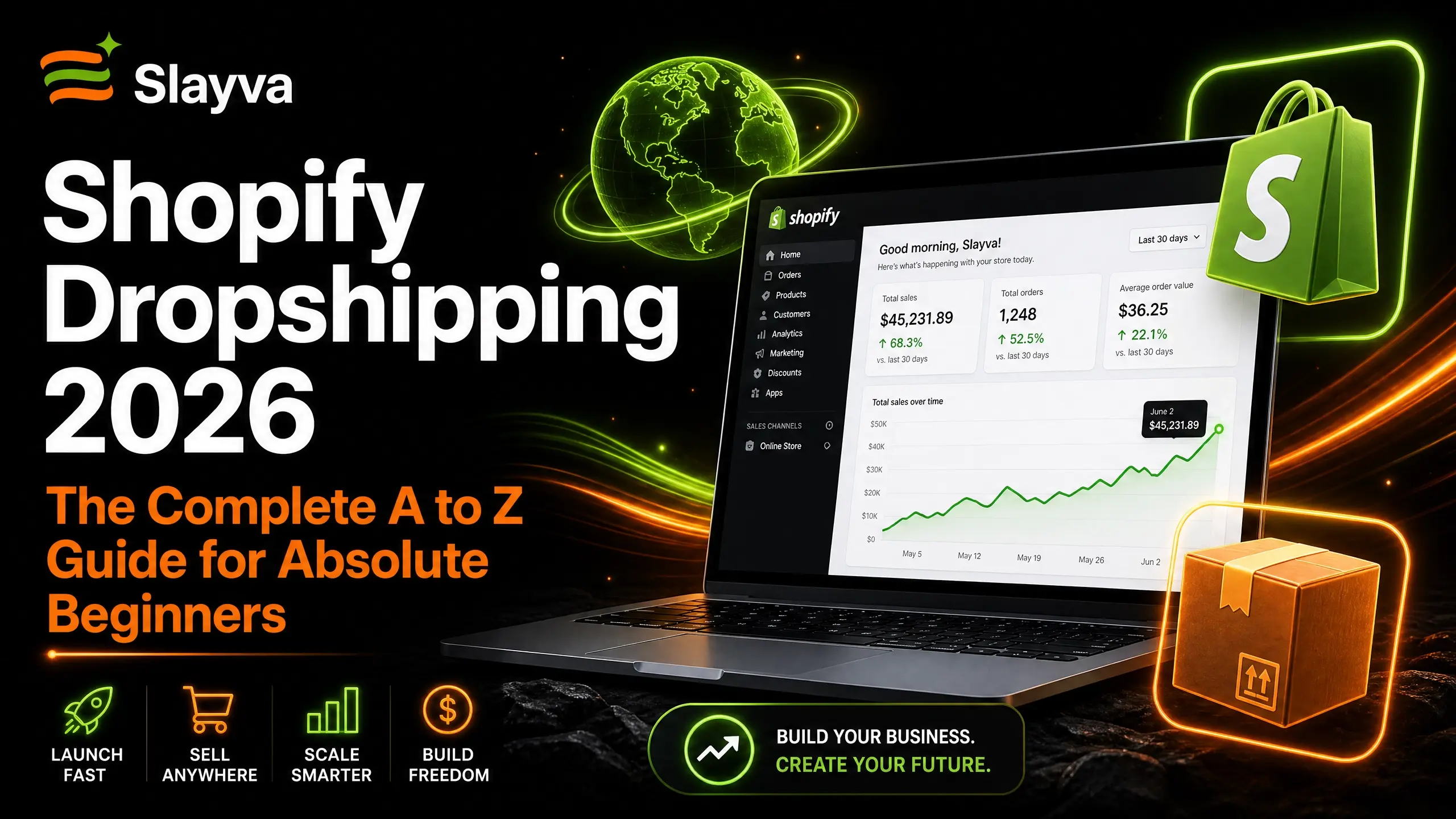
Introduction: Is Shopify Dropshipping Still Worth Starting in 2026
Every few months someone publishes an article declaring dropshipping dead. And every few months a new wave of sellers proves that article wrong by quietly building five and six-figure stores from their laptops.
Shopify dropshipping is not dead. It is just more competitive than it was in 2018, which means the sellers who take it seriously and learn the fundamentals properly are the ones pulling away from the crowd. The sellers who throw up a generic store with random products and no real strategy are the ones complaining on Reddit that it does not work.
This guide is not written for the second group. It is written for someone who actually wants to understand how Shopify dropshipping works in 2026, what it costs, what to avoid, and how to build something real rather than just hope for a viral product.
Whether you have zero experience or have dabbled and not quite cracked it yet, this is the guide I wish existed when I was starting out.
“Shopify dropshipping is not a lottery ticket. It is a business model. Treat it like one and your odds improve dramatically.”
What Is Shopify Dropshipping and How Does It Work
The Basic Business Model
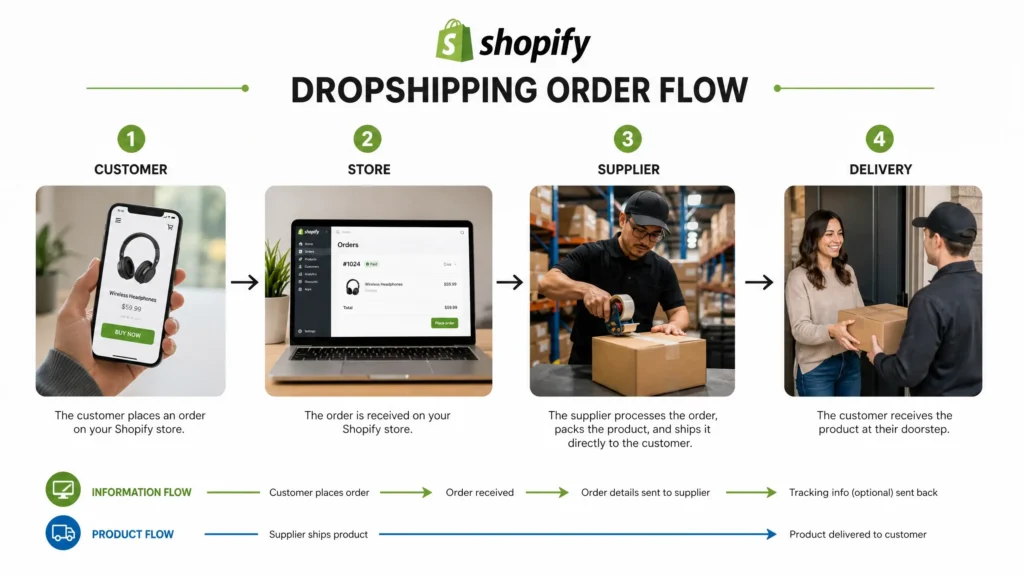
Shopify dropshipping is a retail fulfilment method where you sell products through your own Shopify store without ever holding physical inventory. When a customer places an order, you purchase the item from a third-party supplier who then ships it directly to the customer on your behalf.
You never touch the product. You never pack a box. You never deal with a warehouse. Your job is to build the store, find the right products, bring in customers, and manage the relationship between buyer and supplier.
The margin you make is the difference between what your customer pays you and what you pay your supplier. Sell a kitchen gadget for $39.99. Buy it from your supplier for $11. Keep the difference after fees. That is Shopify dropshipping in its simplest form.
Why 2026 Is Still a Good Time to Start
The tools available to beginner dropshippers in 2026 are significantly better than they were even three years ago. AI product research tools, faster global shipping from suppliers like CJdropshipping and Zendrop, native TikTok marketing, and improved Shopify apps have lowered the learning curve considerably.
The market has also matured in a useful way. Customers are more comfortable buying from independent stores than ever before, and social commerce has created entirely new discovery channels that did not exist for early dropshippers. According to data from Statista, the global dropshipping market is expected to surpass $500 billion by 2027. That is not a saturated market. That is a growing one.
How to Start Shopify Dropshipping for Beginners With No Money
This is the most searched version of this topic and also the most misrepresented. Let us be honest about what starting Shopify dropshipping with no money actually means.
What “No Money” Actually Means Here
You cannot start a functioning Shopify dropshipping store with literally zero dollars. What you can do is start with a very small amount, far less than most people assume. The “no money” framing usually means no money for inventory, which is genuinely true. You do not buy stock upfront. You only pay suppliers after a customer pays you first. That is the single biggest financial advantage of the Shopify dropshipping model.
Minimum Realistic Budget for 2026
Here is an honest breakdown of what you actually need to get started:
| Expense | Estimated Cost |
|---|---|
| Shopify Basic Plan | $39/month |
| Domain Name | $14/year |
| DSers (free plan available) | $0 |
| Product samples (optional but smart) | $30–$60 |
| Initial ad testing budget | $100–$300 |
| Total to get started | ~$150–$400 |
You can further reduce this by taking advantage of Shopify’s free trial which allows you to build and test your store before your first billing cycle. That buys you real time to find a product and set everything up without paying until you are ready to go live.
The goal for absolute beginners should not be zero spend. It should be smart minimal spend with a clear plan for how each dollar is being used.
Setting Up Your Shopify Store Step by Step
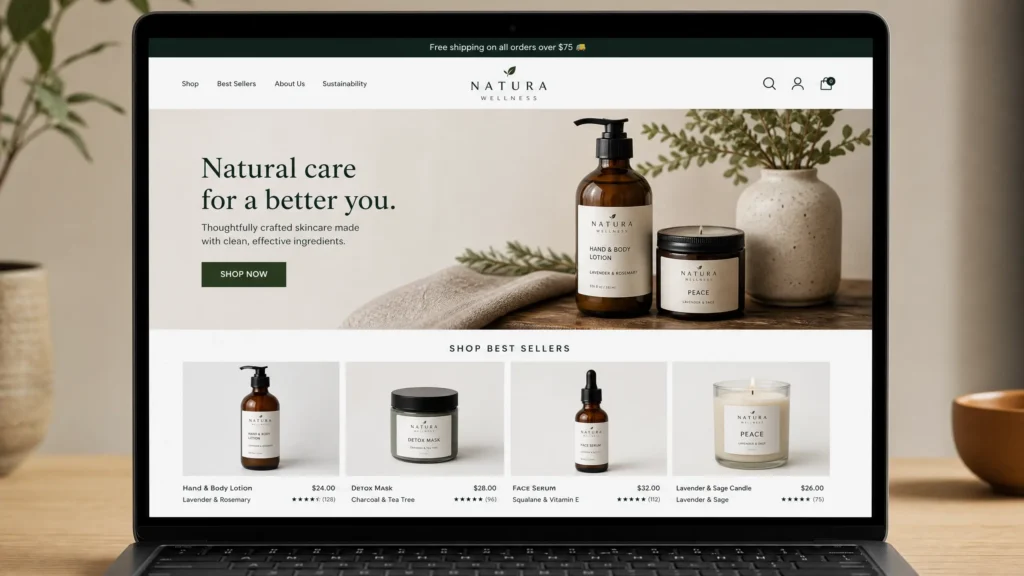
Choosing Your Store Name and Domain
Your store name should be short, easy to spell, and either niche-specific or broad enough to expand into multiple product categories. If you are building a pet store, something like “PawRoutine” or “FurHaven” signals your niche immediately. If you want flexibility to pivot, a broader brand name gives you room to grow.
Check name availability on Namecheap or buy your domain directly through Shopify. Keep it clean. Avoid hyphens, numbers, or anything that is difficult to say out loud.
Picking the Right Shopify Plan
For Shopify dropshipping beginners, start on the Basic plan at $39 per month. It covers everything you need to operate a functional store. Do not jump to higher plans until your revenue justifies it. The main reason to upgrade eventually is to reduce transaction fees as your volume grows.
A full breakdown of Shopify’s plans is available on their official pricing page.
Essential Apps Every Dropshipper Needs
Do not install twenty apps in your first week. The stores that perform best are often the leanest. Start with these:
- DSers or AutoDS for supplier and order management
- Vitals or Loox for reviews and social proof
- Klaviyo for email marketing from day one
- Tidio or Gorgias for customer support chat
- PageFly if you want more control over your landing pages
Each of these has a free tier or trial that is sufficient for a beginner Shopify dropshipping setup. Add more only when you identify a specific gap the apps above do not cover.
Best Dropshipping Suppliers for Shopify Beginners 2026
Choosing the right supplier is genuinely one of the most important decisions in Shopify dropshipping. Bad suppliers mean slow shipping, poor product quality, and angry customers. Good suppliers become the backbone of a store that runs reliably.
AliExpress
AliExpress is still the most commonly used starting point for Shopify dropshipping beginners, and for good reason. The product range is enormous, prices are low, and it integrates directly with tools like DSers. The main downside is shipping times. Standard AliExpress shipping can take 15 to 30 days to Western markets, which is a real customer experience problem in 2026. Mitigate this by selecting suppliers that offer AliExpress Standard Shipping or ePacket delivery and by being transparent with customers about timelines.
DSers
DSers is the official AliExpress dropshipping partner and the most efficient way to manage AliExpress orders within your Shopify dropshipping store. It automates order fulfilment, tracks inventory levels, and lets you place bulk orders with a few clicks. The free plan covers up to 3,000 products which is more than enough when you are starting out.
Zendrop
Zendrop is a US-based supplier platform designed specifically for Shopify dropshipping. The major advantage over AliExpress is significantly faster shipping, with many products delivered in 5 to 10 days to US customers. They also offer custom branding and private labelling options as you scale. Pricing starts free with a paid plan at $49 per month for faster shipping access.
Spocket
Spocket focuses on suppliers based in the US and EU, which means dramatically faster delivery times than most AliExpress options. Products on Spocket tend to be higher quality and slightly higher cost, which suits stores targeting a more premium customer. If you are building a Shopify dropshipping store aimed at a conscious buyer willing to pay more for better products and faster shipping, Spocket is worth considering.
CJdropshipping
CJdropshipping has become a serious competitor to AliExpress for Shopify dropshipping in 2026. They offer warehousing in the US, UK, and EU for faster local delivery, product sourcing on request, and better shipping options than standard AliExpress. For sellers scaling past their first few sales, CJdropshipping often becomes the preferred supplier upgrade.
| Supplier | Shipping Speed | Cost | Best For |
|---|---|---|---|
| AliExpress via DSers | 15–30 days | Very Low | Complete beginners |
| Zendrop | 5–10 days (US) | Free/$49+ | US-focused stores |
| Spocket | 3–7 days | $39+/month | Premium product stores |
| CJdropshipping | 5–15 days | Free to use | Scaling sellers |
| AutoDS | Varies | $19+/month | Automation-focused sellers |
Shopify AliExpress Dropshipping Step by Step Tutorial 2026
[Image Suggestion 1: Clean diagram showing the Shopify dropshipping order flow from customer to store to supplier to delivery. Alt text: “How Shopify dropshipping works step by step for beginners in 2026”]
The most common starting path for beginners is the Shopify AliExpress dropshipping combination, so let us walk through exactly how it works in practice.
Step 1: Find Your Product on AliExpress
Go to AliExpress and search your niche category. Filter results by orders (high volume indicates proven demand), look for suppliers with a feedback score above 95%, and check that the product has clear photos and detailed descriptions you can work with.
Pay attention to shipping options. Always filter for suppliers offering AliExpress Standard Shipping or ePacket to the country you are targeting. Avoid suppliers with shipping times listed as 45 to 60 days. That is a customer service disaster waiting to happen.
Step 2: Connect DSers to Your Shopify Store
Install DSers from the Shopify App Store, connect it to your AliExpress account, and link it to your Shopify dropshipping store. The setup takes about ten minutes and the DSers documentation walks you through every step clearly.
Step 3: Import the Product to Your Store
Once DSers is connected, you can import any AliExpress product directly to your Shopify store with a single click. From there, edit the product title, write your own description, select which variants to include, and set your pricing.
Step 4: Set Your Pricing for Healthy Margins
The pricing formula most Shopify dropshipping beginners use is a simple 2x to 3x markup on supplier cost, then adjusted based on what comparable products sell for in the market. On a product costing $9 from AliExpress, a $24.99 to $29.99 retail price is reasonable depending on the category. Always factor in your platform fees, payment processing, and ad spend before deciding if the margin actually works.
Step 5: Process Orders Through DSers
When an order comes in, DSers lets you fulfil it on AliExpress in seconds. The supplier receives the order details, ships directly to your customer, and DSers updates the tracking information in your Shopify store automatically. You do not manually touch any of this after the initial setup.
Most Profitable Dropshipping Niches for Shopify in 2026
Niche selection is where most beginners either get it right early and gain momentum, or pick something oversaturated and grind without results for months. Here are the categories showing the strongest performance in Shopify dropshipping heading into 2026.
Health and Wellness
This is one of the consistently strongest categories in Shopify dropshipping year over year. Posture correctors, massage tools, sleep aids, resistance bands, and supplement accessories all convert well with the right positioning. Customers in this niche are motivated buyers actively looking for solutions to specific problems, which makes ad targeting more precise and cost-effective.
Home and Kitchen
Kitchen gadgets that solve a specific cooking problem continue to be among the most viral Shopify dropshipping products. Space-saving organizers, specialty prep tools, and clever storage solutions all perform well across TikTok and Meta ads. The category benefits from strong visual demonstration potential, which makes content creation straightforward.
Pet Products
Pet owners spend without much hesitation on products that improve their pet’s comfort, health, or appearance. Grooming tools, interactive toys, travel accessories, and orthopedic beds are strong Shopify dropshipping performers. The repeat purchase rate in this category is also above average, which helps long-term store profitability.
Baby and Parenting
High-consideration purchases from highly motivated buyers. Parents research products carefully and pay premium prices for quality and safety. This makes it a slightly harder niche to enter with standard Shopify dropshipping inventory, but the average order values and customer lifetime value are significantly higher than most other categories.
Tech Accessories
Phone cases, cable organizers, laptop stands, and portable chargers are reliable Shopify dropshipping staples. Margins can be tighter due to competition, but product research tools like Minea or Sell The Trend consistently surface untapped tech accessory products that are trending before they hit saturation.
Finding Winning Products in 2026
Tools to Use for Product Research
- Minea: Tracks winning ads across TikTok, Facebook, and Pinterest. One of the most used product research tools in the Shopify dropshipping community in 2026.
- Sell The Trend: Combines trend data with supplier integration and store analysis in one dashboard.
- Google Trends: Free, underused, and genuinely useful for validating whether interest in a product category is growing or declining before you invest.
- TikTok’s own Creative Center: Shows trending sounds and content categories. Browse it for product ideas that are already generating organic content.
What Makes a Winning Dropshipping Product
There is a pattern to products that consistently perform in Shopify dropshipping. They solve a clear and immediate problem. They are difficult to find in standard retail stores. They look good in a short video. They have a price point between $25 and $70 where impulse purchasing still happens. They are not easily identifiable as an AliExpress product to the average consumer.
Products that hit all five of those criteria are rare. Products that hit three or four of them consistently outperform the average.
Driving Traffic to Your Shopify Dropshipping Store
Building a store is the easy part. Getting traffic to it is where most Shopify dropshipping beginners get stuck. Here are the three most practical channels in 2026.
Paid Traffic: Meta Ads
Meta (Facebook and Instagram) remains the most reliable paid traffic channel for Shopify dropshipping despite rising costs. The targeting options, the volume of potential customers, and the ability to scale winning ads quickly make it the default choice for most experienced dropshippers.
Start with a simple video ad creative showing the product solving a problem. Keep your initial daily budget between $20 and $50. Test two to three different creatives and audiences simultaneously. Kill what is not converting within 48 to 72 hours and scale what is.
Meta’s Business Help Centre is the most reliable resource for learning the ads platform basics without paying for a course.
Organic: TikTok and Instagram Reels
TikTok organic content has become a legitimate traffic driver for Shopify dropshipping stores in 2026. A single well-made video demonstrating your product can generate thousands of store visits without any ad spend. The trade-off is consistency. You need to post regularly and accept that most videos will underperform until one breaks through.
Instagram Reels works on the same principle and cross-posting between the two platforms multiplies your reach without doubling your content creation effort.
SEO for Shopify Dropshipping Stores
SEO is the slowest traffic channel but the most sustainable. Optimizing your product titles, descriptions, and collection pages for search means that over time you attract buyers who are actively searching for exactly what you sell. For Shopify dropshipping beginners, basic on-page SEO and a few well-written blog posts targeting long-tail keywords are enough to start building organic visibility.
Ahrefs and Ubersuggest are both good starting points for keyword research at beginner to intermediate level.
Managing Orders, Returns, and Customer Service
This part of Shopify dropshipping does not get enough attention in beginner guides and it is where a lot of stores quietly fail.
Setting Clear Expectations
Your store’s shipping policy needs to be honest and visible. If products are coming from overseas suppliers with 15-day shipping windows, say so clearly at checkout and in a dedicated shipping policy page. Customers who are surprised by shipping times generate chargebacks. Customers who knew upfront are generally fine with it.
Handling Returns
Most Shopify dropshipping stores operate a return policy of 14 to 30 days, but the operational reality is that you typically handle returns by offering a refund without requiring the customer to send the product back. The cost of a returned item shipping from a US customer to a Chinese supplier usually exceeds the product value. Refund and move on. Factor a 2% to 4% refund rate into your margin calculations from the start.
Customer Support
Install a live chat app on your store from day one. Customers who can ask a quick question before purchasing convert at a higher rate. Customers who cannot reach you after a problem escalate to chargebacks instead of asking for help. Apps like Tidio or Gorgias integrate directly with Shopify and handle both live chat and email support in one place.
Common Mistakes Beginners Make in Shopify Dropshipping
These are the patterns that consistently hold new sellers back.
Launching too many products at once. Beginners often think more products means more chances of success. What it actually means is that you have no clear idea which product deserves your marketing focus. Start with one to three hero products and build around them.
Ignoring product quality. Not ordering samples before you sell is a gamble that frequently backfires. A $15 sample order tells you everything about the product quality, packaging, and real shipping time before you stake your reputation on it.
Setting margins too thin. Pricing a $9 supplier product at $14.99 because you are afraid of looking expensive leaves no room for ad spend, fees, or refunds. Price for margin, not just for volume.
Giving up after one failed product. Most successful Shopify dropshipping stores went through multiple product failures before finding a winner. The skill is in testing efficiently and learning from each attempt, not in getting it right the first time.
Choosing the wrong niche based on personal interest. Your favourite hobby is not necessarily a profitable Shopify dropshipping niche. Market demand matters more than personal passion when you are building a business rather than a hobby.
Shopify Dropshipping Costs and Profit Margins
Let us run a realistic profit scenario so the numbers are completely clear.
You are selling a portable laptop stand for $44.99. Your AliExpress supplier cost including shipping is $11. Here is what your margin actually looks like:
| Item | Amount |
|---|---|
| Sale Price | $44.99 |
| Supplier Cost | $11.00 |
| Shopify Payments Processing (2.9% + $0.30) | $1.61 |
| Shopify Plan (amortized at 100 orders/month) | $0.39 |
| Meta Ad Cost Per Conversion (estimated) | $10.00 |
| Total Costs | $23.00 |
| Net Profit Per Order | $21.99 |
| Net Margin | ~49% |
At 100 orders per month that is roughly $2,200 in net profit from a single Shopify dropshipping product. At 300 orders, you are looking at $6,600. These are realistic numbers for a product with proven demand, not aspirational ones.
The math works. The execution is the variable.
FAQ: Shopify Dropshipping for Beginners 2026
Is Shopify dropshipping still profitable in 2026?
Is Shopify dropshipping still profitable in 2026?
Yes. Shopify dropshipping remains profitable in 2026 for sellers who select the right niche, choose reliable suppliers, and invest in learning proper marketing. The model is more competitive than it was five years ago, which means execution matters more, but the opportunity is absolutely still real.
How much money do I need to start Shopify dropshipping?
Realistically, between $150 and $400 to get your store live, order a sample, and run initial ad tests. You can start even leaner using Shopify’s free trial and organic traffic through TikTok, but having at least $200 to $300 gives you meaningful room to test and learn.
How long does it take to make your first sale with Shopify dropshipping?
With paid ads and a validated product, some sellers make their first sale within days of launching. With organic traffic only, it typically takes a few weeks to a few months. The honest answer is that it depends heavily on your product choice, your store quality, and your marketing effort.
What is the best Shopify dropshipping supplier for beginners?
AliExpress via DSers is the most accessible starting point because of the product variety and low cost. As you scale, CJdropshipping and Zendrop offer faster shipping options that improve customer experience without significantly cutting into margins.
What is the best Shopify dropshipping supplier for beginners?
Requirements vary by country and region. In most places you can legally test and validate a Shopify dropshipping business before formally registering a business entity. Once you are generating consistent revenue, registering a proper business structure is the smart move both legally and for tax purposes. Consult a local accountant or business advisor for guidance specific to your location.
How do I find winning products for Shopify dropshipping in 2026?
Use product research tools like Minea, Sell The Trend, or Sell The Trend combined with manual browsing of TikTok’s trending content in your niche. Look for products that solve a visible problem, are not widely available in retail stores, and have a price point that supports a healthy margin after all costs.
Can I do Shopify dropshipping without running paid ads?
Yes, and many beginners start this way using TikTok organic, Instagram Reels, and Pinterest. Organic traffic takes longer but costs nothing beyond your time. Most sellers eventually combine organic and paid traffic as their store grows.
What are the most profitable dropshipping niches for Shopify in 2026?
Health and wellness, home and kitchen gadgets, pet products, and baby and parenting categories consistently show strong conversion rates and healthy margins. Tech accessories remain competitive but viable with thorough product research.
Is Shopify dropshipping passive income?
In the early stages, no. Building and managing a Shopify dropshipping store requires active work: product research, ad management, customer service, supplier communication, and constant testing. As your store matures and systems are in place, it becomes more manageable with less daily input. But calling it passive income, especially as a beginner, sets unrealistic expectations.
What happens if my Shopify dropshipping supplier runs out of stock?
If you are using DSers, you can set up automatic notifications for low inventory. When a product goes out of stock, remove it from your store immediately to avoid taking orders you cannot fulfil. Always have one or two backup suppliers identified for your best-performing products in case your primary supplier has availability issues.
Conclusion: Your Next Step With Shopify Dropshipping
Shopify dropshipping in 2026 is still one of the lowest-barrier entry points into ecommerce for absolute beginners. You do not need a warehouse, a team, or a massive budget to start. You need a solid product, a properly built store, a reliable supplier, and the discipline to test and improve consistently.
This guide has walked you through every component of Shopify dropshipping from the business model basics to supplier selection, product research, traffic generation, and realistic profit expectations. The framework is all here. What comes next is entirely on you.
Pick a niche that has real demand. Find a product that solves a clear problem. Set up your Shopify dropshipping store the right way from day one. Order a sample before you sell to anyone else. Then start driving traffic and pay close attention to what the data tells you.
The sellers making real money with Shopify dropshipping in 2026 are not the ones waiting for a perfect moment or the perfect product. They are the ones who started, adjusted, and kept going. That is the only meaningful advantage in this business.
Start today. Improve tomorrow.