
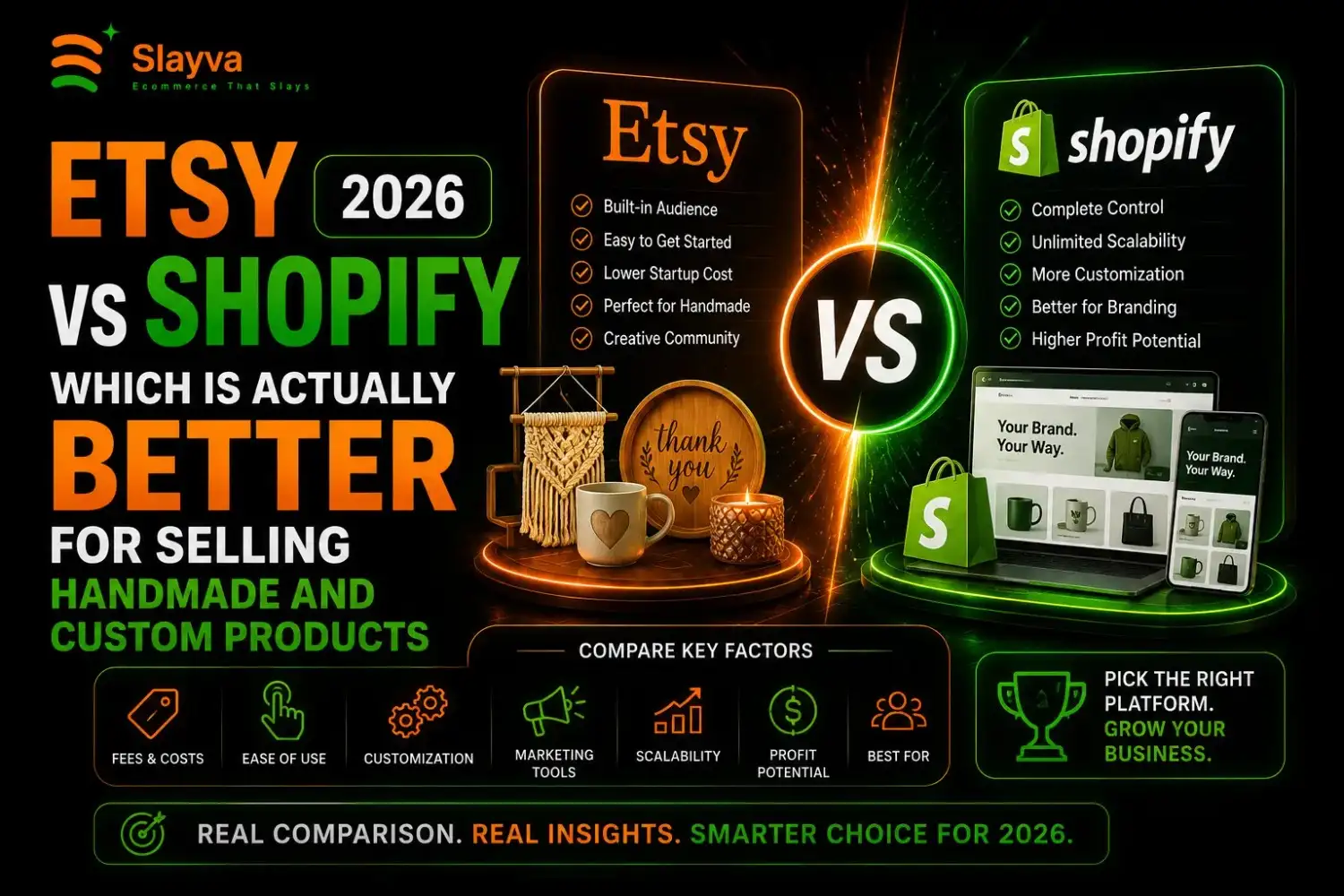
Choosing between Etsy vs Shopify stops many handmade sellers before they ever make a sale. You have products ready. You have photos taken. You have packaging supplies stacked in the corner. But you stare at two platform options and freeze.
One promise built-in traffic from millions of buyers searching for handmade goods. The other promises complete control over your brand and customer relationships. Both claims are true. Both platforms work. But they work for different sellers with different goals.
This guide compares Etsy vs Shopify specifically for handmade and custom product sellers in 2026. You will see real fee comparisons. You will understand traffic differences. You will learn which platform matches your business stage and growth plans. By the end, the choice between Etsy vs Shopify becomes clear.
Key Takeaways
- Main Insight: Etsy provides immediate access to 96 million active buyers searching for handmade products. Shopify gives complete brand control. The right choice between Etsy vs Shopify depends on your business stage and long-term goals for your handmade business.
- Strategy Tip: Start with Etsy to validate products and build initial sales. Add Shopify once you generate consistent monthly orders and want to build an independent brand. Many sellers use both platforms as part of their overall Etsy vs Shopify strategy.
- User Benefit: Understanding the true cost difference between Etsy vs Shopify prevents underpricing your products. Many sellers lose money by not accounting for all platform fees before setting prices on either platform.
Quick Comparison: Etsy vs Shopify for Handmade Sellers in 2026
Before diving deep, here is the direct comparison between Etsy vs Shopify for handmade business owners.
Etsy Overview
Etsy is a marketplace with 96 million active buyers. You can explore current seller resources on the Etsy Seller Handbook. Customers visit Etsy specifically searching for handmade, vintage, and custom items. The platform handles hosting, security, and payment processing. You pay listing fees and transaction fees on each sale.
Etsy works best for sellers who want immediate exposure to ready-to-buy customers and do not want to build traffic from scratch. For many beginners, Etsy vs Shopify is not even a question because Etsy removes the traffic burden entirely.
Shopify Overview
Shopify is an e-commerce platform where you build your own standalone website. You can compare plans on the Shopify Pricing page. You control every aspect of your store design, branding, and customer experience. The platform provides the technology. You bring the traffic through your own marketing efforts.
Shopify works best for sellers who want to build a long-term brand asset and keep more profit per sale. When comparing Etsy vs Shopify for brand building, Shopify wins without question.
Etsy vs Shopify Quick Comparison Table
| Feature | Etsy | Shopify |
|---|---|---|
| Monthly Cost | Free to start, $10 for Plus | 39Basic,105 Shopify, $399 Advanced |
| Transaction Fees | 6.5% of sale price | 2.9% + $0.30 payment processing |
| Listing Fees | $0.20 per item per 4 months | None |
| Built-in Traffic | 96 million active buyers | None, you drive your own |
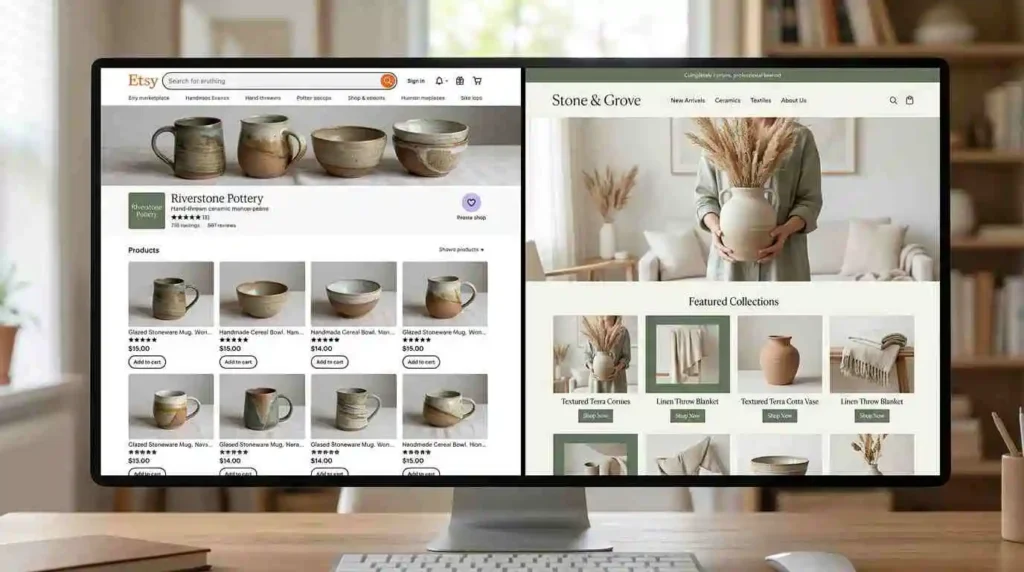
| Brand Control | Limited, marketplace design | Complete customization |
| Customer Data | Limited access | Full ownership of data |
| Setup Time | 1-2 hours | 2-5 days |
| Best For | Beginners, validation, side income | Growing brands, full-time businesses |
Etsy vs Shopify: Which Is Better for Handmade Sellers 2026: Platform Deep Dive
The choice between Etsy vs Shopify starts with understanding how each platform operates for handmade product sellers specifically.
How Etsy Works for Handmade Sellers
Etsy positions itself as the marketplace for handmade goods. Buyers arrive with purchase intent. They search for specific items like “handmade silver necklace” or “custom leather wallet” and browse results from multiple sellers. You can research trending categories using the Etsy Trend Guide.
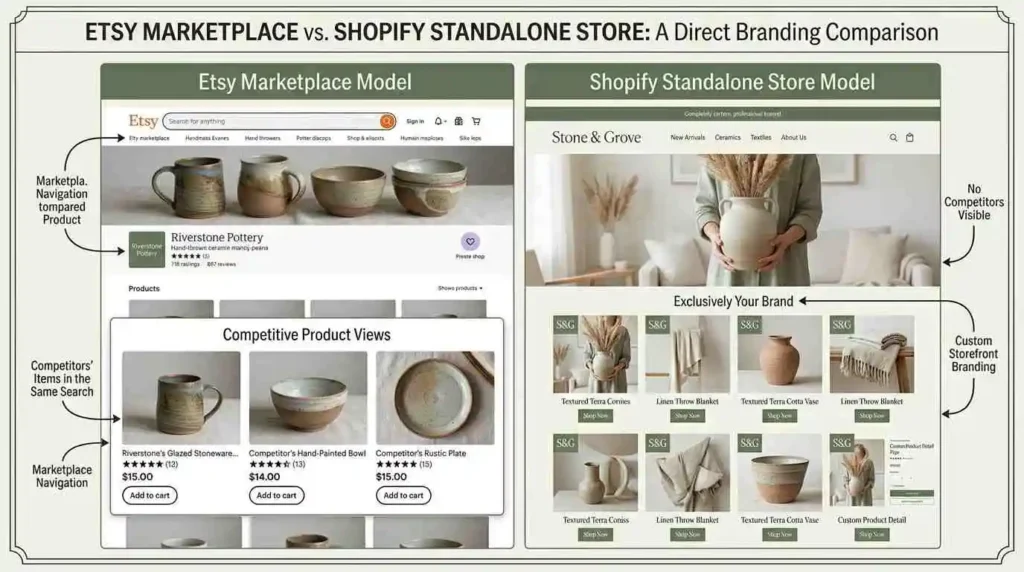
Your products appear alongside competitors in search results. The platform handles product discovery through its internal search algorithm. Sellers optimize listings with keywords and tags to rank higher. Learn more from the Etsy Search Guide. This built-in search visibility makes Etsy vs Shopify appealing for sellers who lack marketing experience.
Etsy handles all technical aspects automatically. Hosting, security updates, payment processing, and mobile optimization happen without seller involvement. You focus on making products and writing listings. The platform also manages some customer communication with automated shipping notifications.
For handmade sellers, Etsy offers specific category structures. You list under Handmade, Vintage, or Craft Supplies. The Handmade category requires items made or designed by you. This focus on handmade goods makes the Etsy vs Shopify comparison relevant specifically for crafters and artisans.
How Shopify Works for Handmade Sellers
Shopify provides the technology to build your own online store. You can start at Shopify Free Trial. You choose a theme, customize the design, add products, and configure settings. The platform handles hosting, security, payment processing, and order management.
Unlike Etsy, Shopify does not bring customers to your store. You attract visitors through your own marketing. Social media content, search engine optimization, email marketing, and word of mouth drive traffic. The Shopify Blog offers free marketing guides. This traffic responsibility is the biggest factor in the Etsy vs Shopify decision.
Shopify gives complete control over brand presentation. Your store looks exactly how you design it. No competitor products appear alongside yours. No marketplace branding competes with your own. The customer experience belongs entirely to you. This brand ownership makes Etsy vs Shopify an easy choice for sellers prioritizing long-term brand building.
Shopify also provides full customer data ownership. Email addresses, purchase history, browsing behavior, and contact information belong to you. You can export data anytime. You build email lists and retargeting audiences. You own the customer relationship completely.
Platform Philosophy Comparison Table
| Aspect | Etsy | Shopify |
|---|---|---|
| Core Model | Marketplace | Store builder |
| Traffic Source | Built-in buyer search | Seller-driven marketing |
| Branding | Etsy-first, shop-second | Your brand only |
| Customer Relationship | Platform-mediated | Direct relationship |
| Technical Management | Fully managed | User-managed with tools |
| Competition Display | Alongside competitors | Your products only |
| Scalability | Limited by platform rules | Unlimited customization |
| Exit Value | Low, platform-dependent | Higher, independent asset |
Etsy vs Shopify Fees, Profits, and Traffic Compared 2026: The Numbers
Understanding financial differences determines which platform generates better profits. Check the Etsy Fees Page and Shopify Payments Terms for official details.
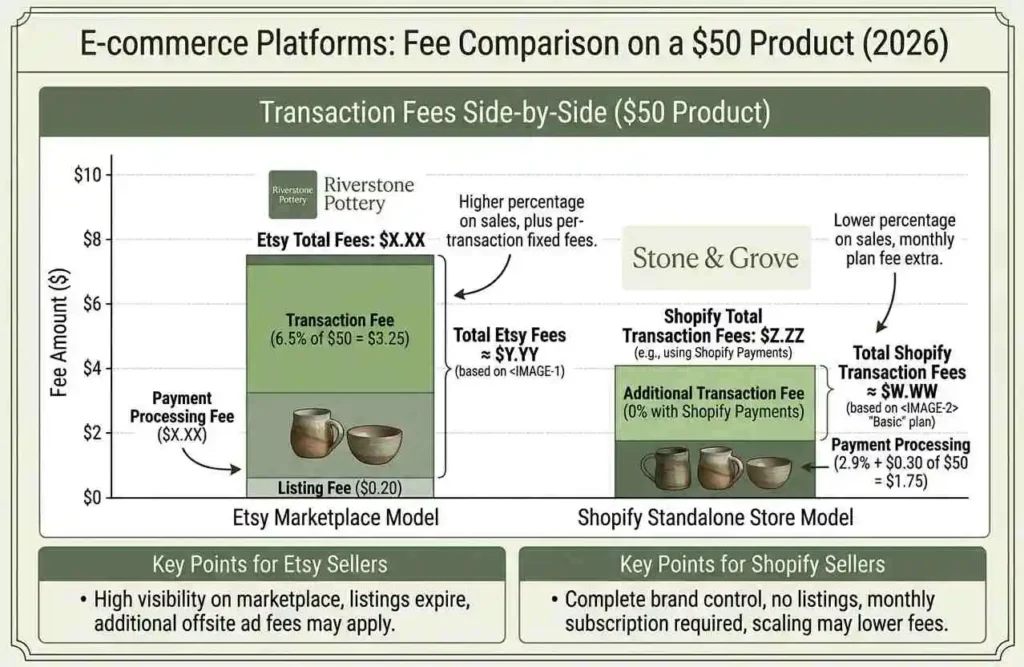
Etsy Fee Structure 2026
Etsy charges multiple fees that add up quickly. Understanding these costs is essential when evaluating Etsy vs Shopify for your handmade business.
Listing Fee: 0.20 per item listed. Each listing lasts four months or until sold.Listing100itemscosts20 every four months regardless of sales.
Transaction Fee: 6.5% of the total sale amount, including shipping costs. On a 50productwith5 shipping, the transaction fee applies to $55.
Payment Processing Fee: 3% plus $0.25 per transaction for US sellers. This varies slightly by country.
Offsite Ads Fee: 15% of the sale amount if a buyer purchases through an Etsy offsite ad. Applies to sellers over $10,000 in the past 12 months. Under that threshold, you can opt out.
Example Fee Calculation on a 50HandmadeProductwith50HandmadeProductwith5 Shipping:
- Listing fee: $0.20
- Transaction fee (6.5% of 55):3.58
- Payment processing (3% + 0.25):1.90
- Total fees: $5.68
- Net revenue before other costs: $49.32
With the Offsite Ads fee, add 8.25. Total becomes 13.93, leaving $41.07. These fees make Etsy vs Shopify calculations important as sales volume grows.
Shopify Fee Structure 2026
Shopify charges a monthly subscription plus payment processing. No listing fees. No additional transaction fees. This fee structure difference defines the Etsy vs Shopify profitability comparison for many sellers.
Shopify Basic: $39 monthly. Unlimited products, 2 staff accounts.
Payment Processing (Shopify Payments): 2.9% plus $0.30 per transaction on the Basic plan. Rates decrease on higher plans.
Example Fee Calculation on the Same $55 Sale:
- Payment processing (2.9% + 0.30):1.90
- No listing fees, no transaction fees, no offsite ad fees
- Total transaction fees: $1.90
- Net revenue before subscription cost: $53.10
The transaction-level savings on Shopify prove significant in the Etsy vs Shopify comparison. However, factor in the $39 monthly subscription and your marketing costs.
Fee Comparison Table for a 50Productwith5 Shipping
| Fee Type | Etsy | Shopify Basic |
|---|---|---|
| Listing Fee | $0.20 | $0.00 |
| Transaction Fee | $3.58 (6.5%) | $0.00 |
| Payment Processing | $1.90 | $1.90 |
| Offsite Ads (if applicable) | $8.25 (15%) | $0.00 |
| Total Per Sale | 5.68to13.93 | $1.90 |
| Monthly Subscription | 0to10 | $39 |
Pros and Cons of Etsy vs Shopify for Small Business Owners
Every platform decision involves trade-offs. Understanding these helps resolve the Etsy vs Shopify question for your specific situation.
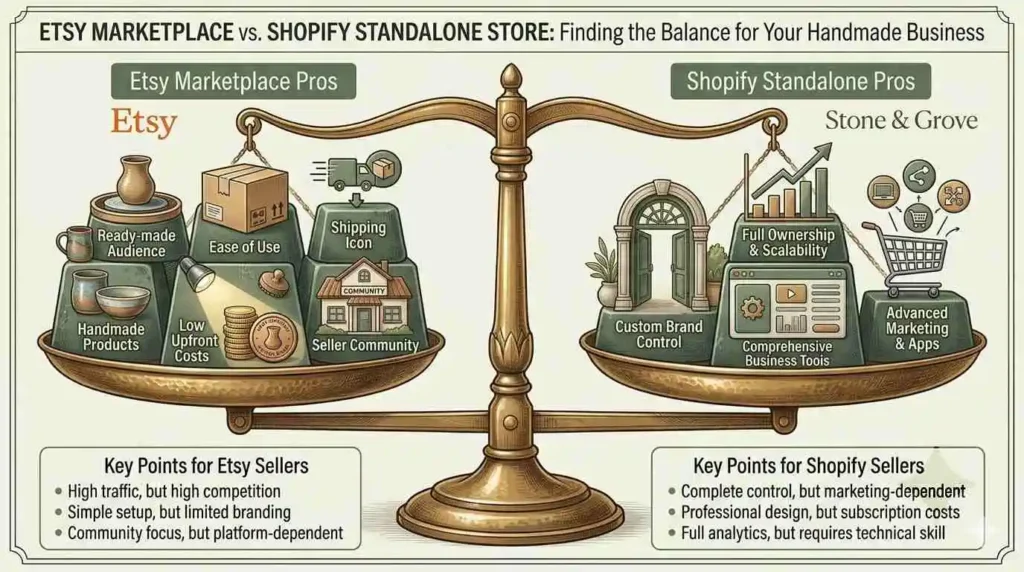
Etsy Pros
Immediate Buyer Access: Exposure to 96 million active buyers searching for handmade items. New shops make sales within days of listing products. No marketing experience required. This makes Etsy vs Shopify straightforward for beginners.
Lower Upfront Cost: Starting requires zero monthly investment. Pay $0.20 per listing and fees only when items sell. This reduces financial risk when testing product ideas.
Simplified Operations: Etsy handles hosting, security, payment processing, and mobile optimization. Technical management stays minimal. Focus remains on making products and fulfilling orders.
Built-in Trust: Buyers trust the Etsy platform. Brand recognition and buyer protection reduce purchase hesitation. New sellers benefit from established marketplace credibility.
Etsy Cons
High Transaction Costs: Combined fees reach 9.5% to 20% plus $0.45 per sale. These eat margins on lower-priced handmade items. High-volume sellers pay thousands monthly.
Limited Brand Building: Your shop exists within the Etsy ecosystem. Customers remember Etsy more than your shop name. Building independent brand awareness proves difficult.
Restricted Customer Data: Limited access to customer email addresses for marketing. Building email lists or retargeting audiences remains challenging.
Platform Dependency: Business lives on rented land. Policy changes, fee increases, or account suspensions happen without recourse. This risk drives many sellers toward Shopify.
Shopify Pros
Complete Brand Control: Store design, messaging, and customer experience reflect your brand alone. Every visit reinforces your identity. Use Shopify Themes for customization.
Full Customer Data Ownership: Collect email addresses, purchase history, and browsing behavior. Build email lists for repeat sales. Create retargeting audiences for advertising.
Lower Per-Sale Fees: Payment processing at 2.9% plus $0.30 costs less than Etsy fees. Higher-volume sellers save substantial amounts monthly. These savings compound as sales grow.
Business Asset Value: A Shopify store with consistent revenue holds resale value. You can sell your business later. Etsy shops offer limited transferability.
Shopify Cons
No Built-in Traffic: Attract every visitor through your own marketing. This requires learning content creation, SEO, and social media. Traffic generation demands a consistent time investment.
Monthly Subscription Cost: The $39 Basic plan charges regardless of sales. New stores with zero revenue still pay monthly fees. This creates pressure to generate sales quickly.
Trust Building from Scratch: New stores lack established credibility. Build trust through professional design, social proof, and clear policies. Conversion rates start lower.
Pros and Cons Summary Table
| Aspect | Etsy Advantage | Shopify Advantage |
|---|---|---|
| Traffic | Built-in buyer audience | Full control over sources |
| Branding | Not applicable | Complete brand ownership |
| Fees | No monthly cost | Lower per-sale fees |
| Setup | Faster, simpler | More customization options |
| Customer Data | Not applicable | Full data ownership |
| Trust | Instant marketplace credibility | Builds brand-specific trust |
Should I Sell on Etsy or Shopify for Custom Products 2026: Decision Framework
Custom products present unique considerations for the Etsy vs Shopify decision. Personalization workflows affect platform suitability.
When Etsy Works Better for Custom Products
Etsy excels when customization is simple. Products with personalization, like name engraving, color choices, or size variations, work well. The variation system handles these options effectively.
Etsy works when buyers search for your product type. If customers search “custom leather keychain” or “personalized name necklace,” you capture demand without marketing spend. Use Google Trends to compare search volume.
Etsy fits when you want low-risk testing. Validate custom product demand before investing in a standalone site. Low upfront costs allow experimentation with different personalization options.
When Shopify Works Better for Custom Products
Shopify wins for complex customization processes. Products requiring detailed customer input benefit from Shopify’s flexibility. Use apps from the Shopify App Store for custom order forms and file uploads.
Shopify suits branded custom experiences. Your personalization process becomes part of your brand story. Custom order forms match store design. Communication happens through branded email.
Shopify saves more on higher-priced custom products. A 200 custom leather bags saves 13 in fees compared to Etsy per sale. These savings multiply quickly when you get Shopify sales without ads.
Hybrid Approach for Custom Sellers
Many sellers use both platforms. List standard variations on Etsy to capture marketplace search traffic. Include descriptions directing buyers to your Shopify store for fully custom orders. This dual approach answers the Etsy vs Shopify question with both options.
Traffic Realities: Understanding Where Your Customers Come From
The traffic difference between Etsy vs Shopify creates the biggest platform divide.
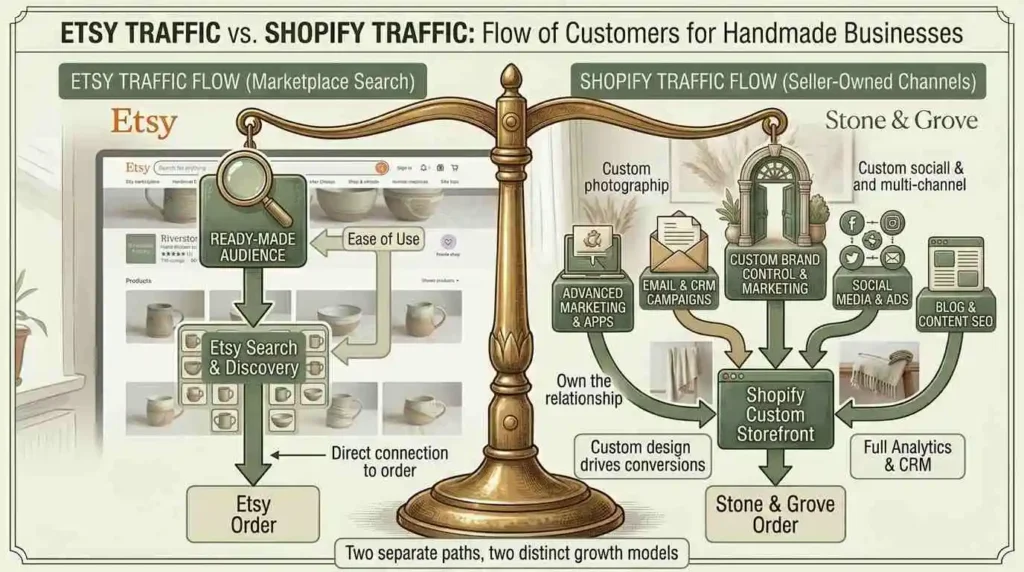
Etsy Traffic Sources
Etsy delivers traffic through built-in channels without seller effort. Buyers type product keywords into the Etsy search. Your listings appear based on relevance and shop quality score. This passive traffic makes Etsy vs Shopify attractive for those avoiding marketing work.
The platform runs advertising on Google and Facebook, promoting Etsy products. Offsite Ads bring external traffic at a cost only when sales occur. Etsy sends personalized product recommendations to registered buyers through email marketing.
Shopify Traffic Sources
Shopify stores require seller-driven traffic generation. No built-in audience exists. Use the Shopify Blog for free marketing guides.
Search engine optimization brings passive traffic through blog content and optimized product pages. Social media content on TikTok, Instagram, and Pinterest drives visitors through bio links. Email marketing brings repeat purchases from existing customers using tools like Mailchimp.
Community engagement on Reddit and Facebook Groups drives curious visitors. Satisfied customers generate referral traffic through word of mouth. Each channel requires consistent effort.
Traffic Comparison Table
| Traffic Aspect | Etsy | Shopify |
|---|---|---|
| Built-in Audience | 96 million buyers | Zero |
| Passive Traffic Potential | High, from marketplace search | Low, requires SEO effort |
| Traffic Control | Limited, algorithm-dependent | Complete control |
| Traffic Consistency | Varies with algorithm | Varies with your consistency |
| Long-term Asset | Platform-dependent | Your owned channels |
Which Platform Should You Choose Right Now
The Etsy vs Shopify decision comes down to your current business stage and goals.
Choose Etsy If You Match These Criteria
Start with Etsy when launching your first handmade product line and wanting to test demand before investing heavily. Choose Etsy when you have limited time for marketing and want the platform to bring customers. Pick Etsy when monthly sales are below 1,000anda39 monthly Shopify subscription feels risky.
Etsy fits when you sell products; buyers actively search for using terms that Etsy ranks well for. Choose Etsy when you prefer focusing on product creation rather than marketing and website management. For these sellers, Etsy vs Shopify resolves clearly toward the marketplace option.
Choose Shopify If You Match These Criteria
Move to Shopify when you consistently generate over $1,000 monthly and Etsy fees exceed Shopify subscription costs. Pick Shopify when you want to build a recognizable brand with a unique visual identity. Choose Shopify when you plan to run paid advertising and want complete control over the customer journey.
Shopify fits when you sell products requiring detailed customization or consultation before purchase. Choose Shopify when you want to build a sellable business asset with documented revenue and customer data. The Etsy vs Shopify decision shifts toward Shopify as brand building becomes a priority.
Use Both Platforms If You Match These Criteria
Maintain both when you generate Etsy sales and want to diversify from platform dependency. Use both when testing Shopify while maintaining Etsy income during the transition. Run both when you sell different product types better suited to different platforms. The Etsy vs Shopify debate often resolves into using both strategically.
Frequently Asked Questions
What is cheaper for a new seller, Etsy vs Shopify?
Etsy costs less upfront. Pay 0.20 per listing and fees only when items sell. Shopify costs $39 monthly regardless of sales. For sellers with zero sales, Etsy presents lower financial risk. However, once monthly sales exceed approximately $600, Shopify fees become more competitive in the Etsy vs Shopify cost comparison.
Can I sell the same products on both Etsy and Shopify?
Yes. Many sellers maintain both platforms simultaneously. Use consistent branding across both. Ensure inventory syncs to prevent overselling. Integration apps from the Shopify App Store help manage dual-platform selling.
How much traffic does Etsy bring compared to what I need to generate for Shopify?
Etsy provides passive traffic from 96 million active buyers. Shopify requires generating all traffic through your marketing efforts. This means Etsy brings immediate visibility while Shopify demands ongoing marketing work. The traffic question often determines the Etsy vs Shopify decision for new sellers.
What happens to my business if Etsy closes my shop?
Etsy can suspend shops for policy violations or intellectual property claims. Recovery options remain limited. This platform dependency risk drives diversification to Shopify. Your Shopify store remains your property regardless of external marketplace actions.
How long does it take to get sales on Etsy versus Shopify?
Etsy sellers often make first sales within days or weeks with optimized listings. Shopify stores typically take weeks or months to generate consistent sales because building traffic requires time. The speed difference shapes the Etsy vs Shopify decision for sellers needing immediate revenue.
Do I need technical skills to run a Shopify store?
Basic Shopify setup requires minimal technical skills. Theme customization uses drag-and-drop editors. The Shopify Help Center provides step-by-step guides. Advanced customizations benefit from technical knowledge but are not required.
Which platform is better for selling digital handmade products like printables?
Etsy excels in digital products because of its built-in buyer search traffic. Customers frequently search for printables and digital downloads. Shopify works well but requires driving your own traffic. The Etsy vs Shopify answer depends on your traffic generation capabilities.
Can I transfer my Etsy reviews to my Shopify store?
Direct review transfer is not possible. However, use review apps from the Shopify App Store to import reviews through CSV files or integration tools. Some apps allow importing Etsy reviews through available export features.
External Resources
Learn selling strategies from the official Etsy Seller Handbook, covering listings, SEO, and shop optimization.
Compare plans and features on the Shopify Pricing page for current subscription costs.
Start a free trial at Shopify Free Trial to explore the platform before committing.
Understand Etsy fees through the Etsy Fees Page with current transaction and listing costs.
Research trending categories using the Etsy Trend Guide for marketplace demand signals.
Find customizable themes on Shopify Themes with free and paid options.
Discover apps on the Shopify App Store for extending store functionality.
Learn marketing from the Shopify Blog with free guides on traffic and sales growth.
Check demand trends using Google Trends for search volume comparison.
Start email marketing with Mailchimp to build customer relationships without monthly cost.
Conclusion
The choice between Etsy vs Shopify for handmade and custom products depends on your current business stage, traffic needs, and brand goals.
Etsy provides immediate access to millions of buyers searching for handmade items. You pay higher per-sale fees in exchange for built-in traffic and simplified operations. This makes Etsy the right starting point for new sellers testing products and building initial revenue.
Shopify provides complete brand control, full customer data ownership, and lower per-sale fees. You trade built-in traffic for independence and higher long-term profit potential. This makes Shopify the right platform for established sellers ready to build an independent brand asset.
Many handmade sellers follow a natural progression. Start on Etsy to validate products and generate first sales. Add Shopify once monthly revenue exceeds $1,000 and brand building becomes a priority. Maintain both platforms during the transition period. Gradually shift focus toward your independent store as traffic and sales grow.
The right platform matches where your business stands today. Start there. Adjust as you grow. The Etsy vs Shopify decision evolves with your handmade business journey.