
Introduction
I spent $3,000 on inventory before I made my first sale.
Boxes of t-shirts filled my garage, sizes I could not sell and colors nobody wanted. I had printed designs I thought were brilliant, but buyers ignored them. That $3,000 investment dwindled to just $800 in recovered costs after six months of aggressive discounting.
I learned an expensive lesson about the “old way” of selling custom products. Today, starting a store is significantly more accessible:
- Platform Fees: A basic Shopify plan costs only $39 monthly.
- Creative Assets: Professional design costs now range from $10 to $50 per design.
- Product Photography: Getting sample products for photography can cost $10-$25 per item.
- Lean Entry: For a store with five products and sample inventory, the total startup cost typically runs between $100 and $300.
By shifting away from bulk inventory and toward a leaner model, you can test designs without the $3,000 risk.
Shopify print on demand changed everything for me. No inventory. No upfront printing costs. No boxes of unsold shirts collecting dust. A customer orders from your store. Your print partner prints the product and ships it directly to the customer. You keep the profit margin.
“Print on demand removes the single biggest barrier to starting a product business. You never buy inventory you have not already sold.”
This guide covers Shopify print on demand in 2026. How to choose products. How to pick the right printing partner. How to create designs that sell. How to launch your store and drive traffic. The complete path from zero to a working custom brand.
What Is Shopify Print on Demand
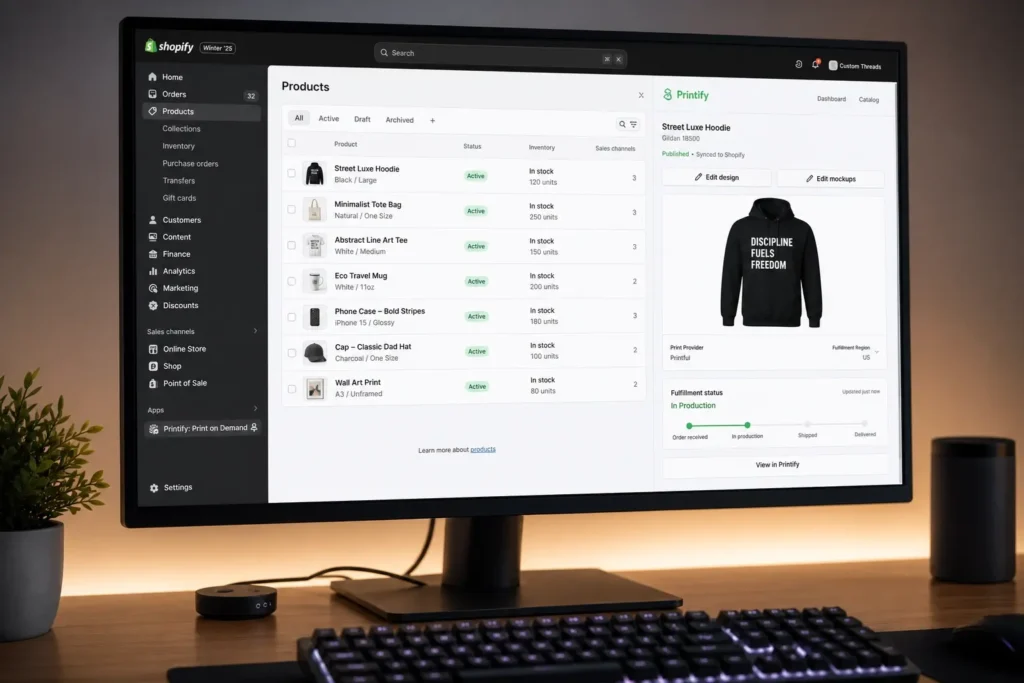
Shopify print on demand connects your store to a printing partner. You create designs and list products on your Shopify store. When a customer orders, the printing partner prints your design on the product. They package it. They ship it to your customer with your branding.
You never touch the product. You never hold inventory. You never visit a post office. Your entire job is creating designs and driving traffic to your store. The printing partner handles production and fulfillment.
According to Shopify’s print on demand business guide, this model eliminates the traditional risks of product businesses. No minimum order quantities. No warehousing costs. No dead stock. You test products with zero financial risk beyond your Shopify subscription.
Shopify print on demand works for many product categories. T-shirts and hoodies lead the market. Mugs and drinkware follow. Phone cases. Tote bags. Wall art. Posters. Pillows. Blankets. Pet products. The product catalog available to print on demand sellers expands every year.
How to Start a Print on Demand Business on Shopify 2026
Launching your Shopify print on demand business follows a clear sequence. Follow these steps in order. Skip nothing.
Here is the complete launch checklist:
- Sign up for Shopify and choose your plan
- Connect a print on demand app to your store
- Research profitable niches and design concepts
- Create or source designs for your chosen products
- Build product listings with mockup photos
- Set your pricing and profit margins
- Configure shipping rates and policies
- Launch your store and drive traffic
Each step takes focused time. You complete a full launch in one weekend if you work efficiently.
Sign Up for Shopify
Go to Shopify.com. Start a free trial. Choose a store name. Your store name becomes your domain. Pick a name that fits your niche.
Select a plan. The Basic plan works for new Shopify print on demand stores. You upgrade as your sales grow. The Basic plan includes everything needed to launch.
Complete the initial setup wizard. Add your business details. Configure your payment processor. Shopify Payments works for most regions. Connect PayPal as a secondary option. Buyers trust both.
Connect a Print on Demand App
Your Shopify store needs a print on demand app. The app connects your product listings to a printing partner. When orders come in, the app routes them to production automatically.
The major Shopify print on demand apps are Printful, Printify, Gelato, and SPOD. Each works differently. Each has strengths. We compare them in detail later in this guide.
Install your chosen app from the Shopify App Store. Create an account with the app. Connect your store. The app syncs your product catalog with available print products.
Best Print on Demand Apps for Shopify Beginners 2026
Choosing the right print partner determines your profit margins and customer experience. Here are the best print on demand apps for Shopify beginners 2026.
Printful
Printful runs its own printing facilities. They control production quality directly. Their print quality is consistent. Their catalog includes apparel, accessories, home decor, and wall art.
Printful offers warehousing for non POD products. You store inventory with them. They fulfill alongside your print on demand orders. This matters if you expand beyond POD later.
Pricing runs higher than competitors. T-shirts start around 12 to 14 base cost. Shipping is reliable and trackable. Branding options include custom labels, packaging, and packaging.
Printful works well for sellers who prioritize product quality and brand experience over maximum margins. Their direct facility control means fewer quality issues and consistent output.
Printify
Printify operates as a marketplace connecting you to multiple print providers. You choose which provider prints your products. Provider quality and pricing vary. You select based on your priorities.
Pricing runs lower than Printful. T-shirts start at around 8 to 10 base cost from budget providers. Premium providers cost more but deliver better quality. Shipping times and costs depend on your chosen provider.
The provider marketplace creates flexibility. Switch providers if quality slips. Choose providers close to your customers for faster shipping. Choose budget providers for higher margins.
Printify works well for sellers who want margin flexibility and are willing to test providers to find reliable partners. The platform rewards active management of your provider relationships.
Gelato
Gelato operates a global network of print facilities. They route each order to the facility closest to your customer. This reduces shipping times and costs for international orders.
Their catalog focuses on paper products, wall art, and apparel. Pricing stays competitive with Printify. The global production network serves sellers with international customer bases.
Gelato works well for sellers targeting customers in multiple countries. The localized production model reduces delivery times across regions.
SPOD
SPOD offers the fastest production times among major POD apps. Orders ship within 48 hours, typically. Their catalog skews toward apparel with limited non-apparel options.
Pricing stays competitive. Integration with Shopify remains straightforward. The speed advantage matters for customer satisfaction and repeat purchases.
SPOD works well for sellers prioritizing fast delivery over catalog breadth. Their limited product range simplifies decision-making for new sellers.
Here is a comparison of the major Shopify print on demand apps:
| Feature | Printful | Printify | Gelato | SPOD |
|---|---|---|---|---|
| Base T-Shirt Cost | 12 to 14 | 8 to 10 | 10 to 12 | 9 to 11 |
| Production Time | 2 to 7 days | 2 to 7 days | 2 to 5 days | 1 to 2 days |
| Product Catalog | 300 plus items | 800 plus items | 200 plus items | 150 plus items |
| Branding Options | Premium | Varies by provider | Good | Basic |
| Best For | Quality focus | Margin flexibility | International sales | Fast shipping |
| Beginner Friendly | Yes | Yes | Yes | Yes |
Printful vs Printify for Shopify Which Is Better 2026
The question of Printful vs Printify for Shopify which is better 2026 depends on your priorities.
Choose Printful When
You prioritize consistent quality over maximum margins. You want premium branding options including custom labels and packaging inserts. You prefer working with one reliable partner rather than managing multiple providers. You sell to customers in regions Printful serves well with their facilities. You want warehousing options for non POD products as you grow.
Choose Printify When
You prioritize profit margins and are willing to test providers. You want the largest product catalog with the most options. You sell products that benefit from localized production near your customers. You want the flexibility to switch providers if quality or pricing changes. You want budget provider options for lower price point products.
The Hybrid Approach
Many successful Shopify print on demand sellers use both platforms. Printful handles premium products and branded orders. Printify handles budget products and high-volume items. This approach maximizes both quality and margin.
Start with one platform. Learn its workflow. Add the second platform once you understand the basics. Managing two platforms from day one creates unnecessary complexity.
How to Make Money with Shopify Print on Demand No Inventory
Making money with Shopify print on demand requires more than listing products. You need designs people want. You need pricing that generates profit. You need traffic that converts to sales.
Finding Profitable Niches
Generic designs do not sell. “Best Dad Ever” t-shirts compete with thousands of identical products. Niche designs sell. Specific audiences buy specific products.
Research niches where passion meets purchasing. Dog breed owners buy breed specific merchandise. Yoga practitioners buy yoga themed products. Nurses buy profession specific items. Gamers buy game genre apparel.
Validate your niche before designing. Search Etsy and Amazon for similar products. Check if items are selling. Check review counts on competitor products. High review counts signal healthy demand.
Creating Designs That Convert
Your designs do not require artistic skill. You hire designers. You use design tools. You license existing artwork.
Hire designers on platforms like Fiverr or Upwork. Provide clear design briefs. Request source files for future edits. Expect to pay 10to50 per design for quality work.
Use design tools like Canva for simple text based designs. Their templates provide starting points. Customize with your niche specific text and elements.
License artwork from sites like Creative Market. Purchase commercial use rights. Apply the artwork to your POD products. This route produces professional designs without hiring custom designers.
The Shopify print on demand course library offers free tutorials on design selection and niche research for new sellers.
Setting Profitable Prices
Your retail price must cover product cost, Shopify fees, payment processing fees, marketing costs, and your profit margin.
A simple pricing formula works for most Shopify print on demand products. Take your base product cost. Multiply by three for the minimum retail price. Multiply by four for a comfortable margin that allows paid advertising.
A t-shirt costing 12baseretailsat36 to $48. This pricing leaves room for free shipping offers and discount campaigns while maintaining profitability.
Marketing Your Store
Traffic does not appear automatically. You drive it through these channels.
TikTok organic content converts well for print on demand products. Create videos showing your products. Demonstrate the quality. Share your design process. Link your store in your bio.
Instagram works for visual niches. Post product photos. Share customer photos. Use relevant hashtags. Build an audience that follows for your niche content.
Pinterest drives long term traffic. Create pins for each product. Link pins to your product pages. Pinterest content surfaces for months or years after posting.
Paid advertising scales successful organic traction. Facebook and Instagram ads target specific audience interests. TikTok ads reach younger demographics. Start with small budgets. Test audiences. Scale winning combinations.
Product Selection and Store Setup
Your product selection shapes your entire Shopify print on demand business. Choose products that match your niche and margin goals.
Starting Product Mix
Begin with three to five core products. T-shirts for broad appeal. Hoodies for a higher average order value. Mugs for gift purchases. Tote bags for eco conscious buyers. Phone cases for younger demographics.
Focus on one or two product types if your niche demands specialization. A yoga niche store might focus on leggings and tank tops. A pet niche store might focus on pet bandanas and owner t-shirts.
Store Theme and Design
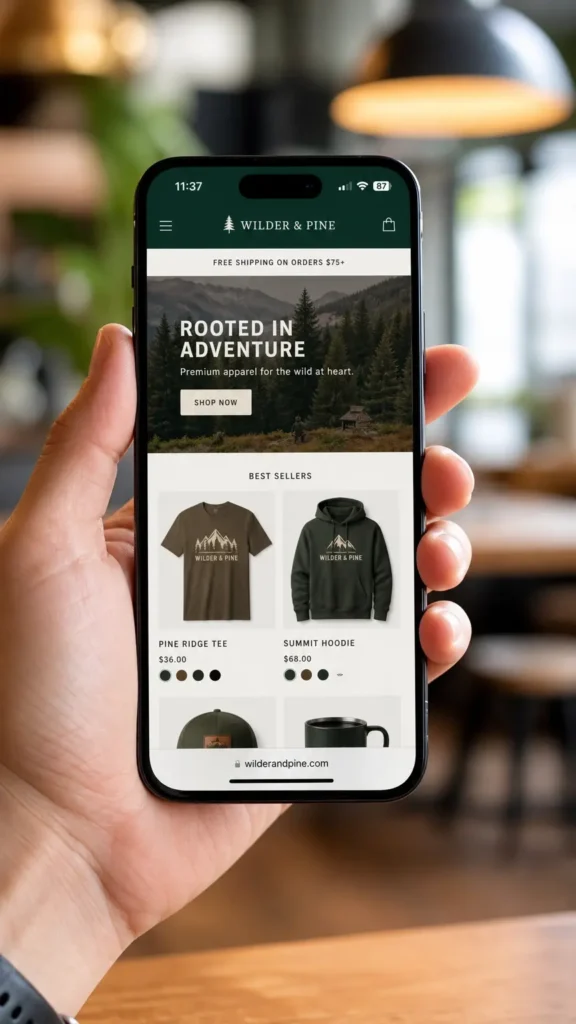
Your Shopify theme affects conversion rates. Choose a clean, fast loading theme. Debut and Dawn are free Shopify themes that work well for Shopify print on demand stores.
Customize your theme with niche appropriate colors and fonts. Use high quality mockup photos for product images. Write product descriptions that speak to your niche audience. Include size guides for apparel products.
Essential Pages
Build trust pages before launching. The About page shares your brand story. The contact page provides customer support access. Shipping policy explains delivery timeframes. Return policy states your process for returns and exchanges. The FAQ page answers common questions.
Complete these pages before driving traffic. Buyers check these pages before purchasing. Missing pages cost you sales.
Order Fulfillment and Customer Experience
Your Shopify print on demand partner handles production. Your job is managing customer expectations.
Setting Accurate Expectations
Print on demand production takes time. Products do not ship the same day. Communicate realistic timeframes on your product pages and shipping policy.
Typical production takes two to seven business days. Shipping adds two to five business days domestically. Total delivery time ranges from five to twelve business days. Set customer expectations at the long end of this range. Faster delivery becomes a positive surprise.
Handling Issues
Print on demand has occasional problems. Misprints happen. Shipping delays happen. Products arrive damaged sometimes. Your response to these issues determines whether customers return.
Replace defective products immediately. Apologize sincerely for the delays. Communicate proactively about issues. A customer who receives excellent support after a problem often becomes more loyal than a customer who never experienced a problem.
Building a Brand Beyond the Product
Branding distinguishes your Shopify print on demand store from competitors. Custom packaging inserts from Printful add an unboxing experience. Thank you cards with discount codes encourage repeat purchases. Branded shipping labels create a professional presentation.
These small touches increase repeat purchase rates. A customer who receives a branded, thoughtful package remembers your store. They return. They tell friends.
Conclusion
Shopify print on demand removes the barriers that stop most people from starting a product business. No inventory investment. No shipping logistics. No printing equipment. No warehouse space.
You need a Shopify store. You need a print on demand app. You need designs for a specific niche audience. You need marketing to drive traffic to your products.
“The difference between dreaming about a product business and owning one is one weekend of focused work. Launch your store. List your products. Start learning what sells.”
Launch your store this weekend. Sign up for Shopify. Install Printful or Printify. Upload three designs to three products. Write your niche focused product descriptions. Publish your store. Post about it on your social channels.
Your first sale might take a week or a month. The time passes regardless. The only variable is whether you use it to build.
Shopify print on demand rewards action. The sellers’ earning full time income started with a weekend launch and a few designs. They learned. They iterated. They grew. Start your clock today.
Frequently Asked Questions About Shopify Print on Demand
How much does it cost to start a print on demand business?
Shopify costs $39 monthly for the Basic plan. Design costs range from $10 to $50 per design if hiring designers. Sample products for photography cost $10 to $25 per item. The total startup cost runs from $100 to $300 for a store with five products and sample inventory.
How much profit per sale can I expect?
Margins vary by product and pricing. T-shirts typically profit $10 to $20 per sale. Hoodies profit $15 to $30. Mugs profit $8 to $15. Phone cases profit $10 to $20. Your specific margins depend on your retail pricing and chosen print provider.
Do I need a business license for print on demand?
Requirements vary by location. Most home based sellers start without formal licensing. Research your local requirements for sales tax collection. Shopify handles tax calculations for most regions once configured.
How long until I make my first sale?
Timeline depends on your marketing efforts. Sellers driving paid traffic often see sales within days. Sellers relying on organic social media typically see first sales within two to four weeks of consistent posting. Sellers who list products without marketing rarely see sales.
Can I sell print on demand products on other platforms?
Yes. Many sellers expand to Etsy, Amazon, and eBay after establishing their Shopify store. Print on demand apps support multi channel selling. Each platform has distinct fees and requirements. Master one channel before expanding.
What products should I avoid in print on demand?
Avoid products requiring precise color matching because screen colors differ from printed results. Avoid complex all-over print designs before understanding print file requirements. Avoid products with tight profit margins that leave no budget for marketing. Start with standard products. Expand to complex items as you learn.
How do I handle returns and exchanges?
Your print on demand partner typically does not accept returns for buyer preference issues like wrong size or changed mind. Your store policy should reflect this. Offer exchanges or store credit for these cases. Replace defective products at your cost through your print partner. Printful and Printify both have defect replacement processes.
Which niche is most profitable for print on demand?
Profitable niches combine passionate audiences with purchasing intent. Pet owners spend on breed specific products. Fitness enthusiasts buy workout apparel. Professionals buy occupation themed items. Hobbyists buy community specific merchandise. The most profitable niches target specific identity groups rather than broad demographics.