How to Get TikTok Shop Creators to Promote Your Products (Seller-Side Affiliate Setup)
- TikTok Shop Marketing & Advertising, TikTok Shop
- 10 min read
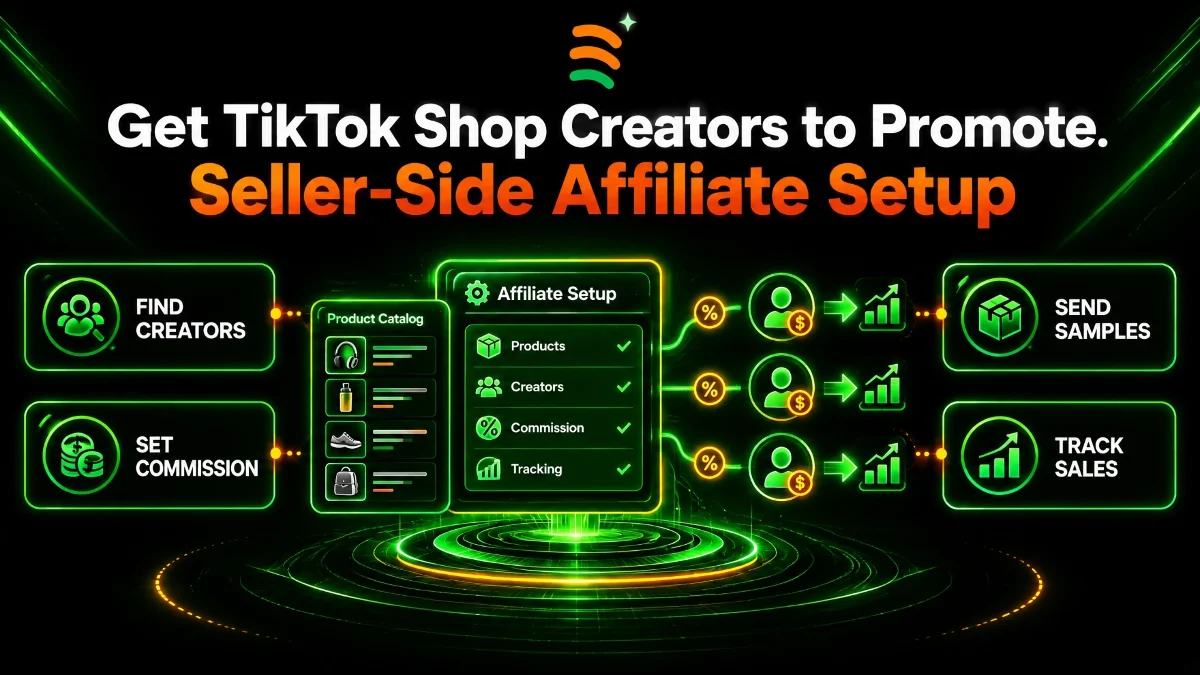
Table of contents
A seller turns on the affiliate programme, sets a commission, and waits. A few sample requests arrive from accounts with no sales history, the samples go out, and no videos come back. A month later the conclusion is that creators do not work for this product. They usually do. The programme was switched on, not run. Working out how to find affiliates for TikTok Shop who will actually sell your products is a process of setting the right commission, choosing creators by what their audience buys, and making it easy for them to post.
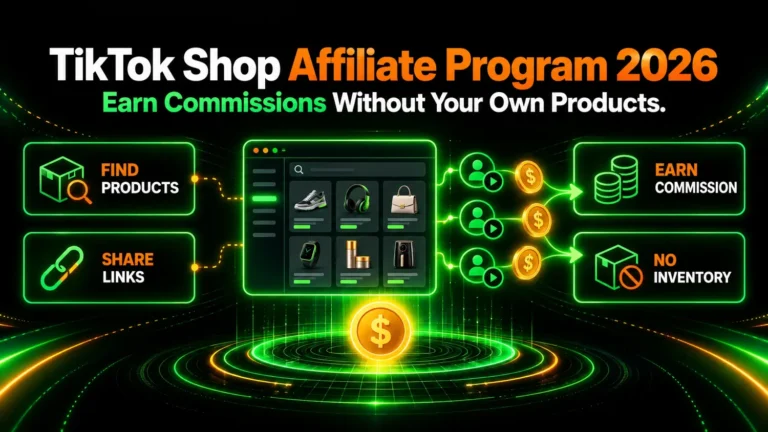
This guide is written for sellers. Our TikTok Shop affiliate programme guide covers the creator side: joining and earning commission. Here we cover the other side of the same programme: how to find affiliates for TikTok Shop, when to use a TikTok Shop open collaboration and when a TikTok Shop targeted collaboration, how to set a TikTok Shop affiliate commission rate your margin can carry, how to handle TikTok Shop free samples, and how to brief creators so their content sells without causing problems for your account.
Key Takeaways
- Main Insight: Finding the right affiliates is less about reach than fit. A creator whose audience buys in your category outsells a larger one whose audience does not.
- Strategy Tip: Run an open collaboration for reach and a targeted collaboration for your best products, and set commission from margin, not from what competitors offer.
- User Benefit: Sellers who approve samples against clear criteria, follow up every sample, and brief creators on what they may claim turn the affiliate programme into a steady sales channel instead of a cost.
How the Seller Side of the Affiliate Programme Works
TikTok Shop’s affiliate programme lets creators promote your products in videos and LIVEs and earn a commission on the sales they drive. As the seller, you decide which products are available to creators, what commission each carries, which creators you invite, and whether you send samples. Everything is managed from the affiliate section of Seller Center, where you can also browse creators and see the results of each collaboration.
Commission is paid on sales attributed to a creator’s content, on top of TikTok Shop’s referral fee, which at the standard US rate is 8 percent. That is the first number to keep in mind when you recruit creators profitably: every creator sale carries both the referral fee and the commission.
TikTok Shop Open Collaboration vs TikTok Shop Targeted Collaboration
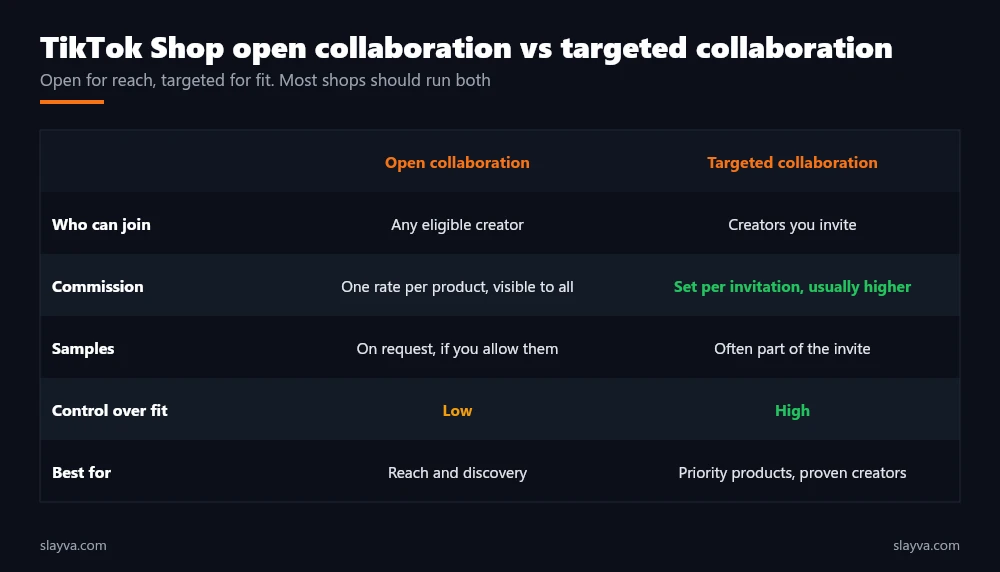
There are two main ways to make products available to creators, and most shops should use both.
A TikTok Shop open collaboration makes selected products available to any eligible creator at the commission you set. It is the reach tool: creators browsing for products to promote can find yours and start without negotiation. The commission has to be attractive enough to stand out among thousands of products, and you have no control over who picks it up.
A TikTok Shop targeted collaboration is an invitation to specific creators, usually at a higher commission, often with samples and a brief. It is the precision tool: you choose creators whose audience fits the product, and you can agree terms for your most important lines. It takes more work and produces better-matched content.
| Factor | Open collaboration | Targeted collaboration |
|---|---|---|
| Who can join | Any eligible creator | Creators you invite |
| Commission | One rate per product, visible to all | Set per invitation, usually higher |
| Samples | On request, if you allow them | Often offered as part of the invite |
| Control over fit | Low | High |
| Best for | Reach and discovery | Priority products and proven creators |
Choosing Creators Who Actually Sell
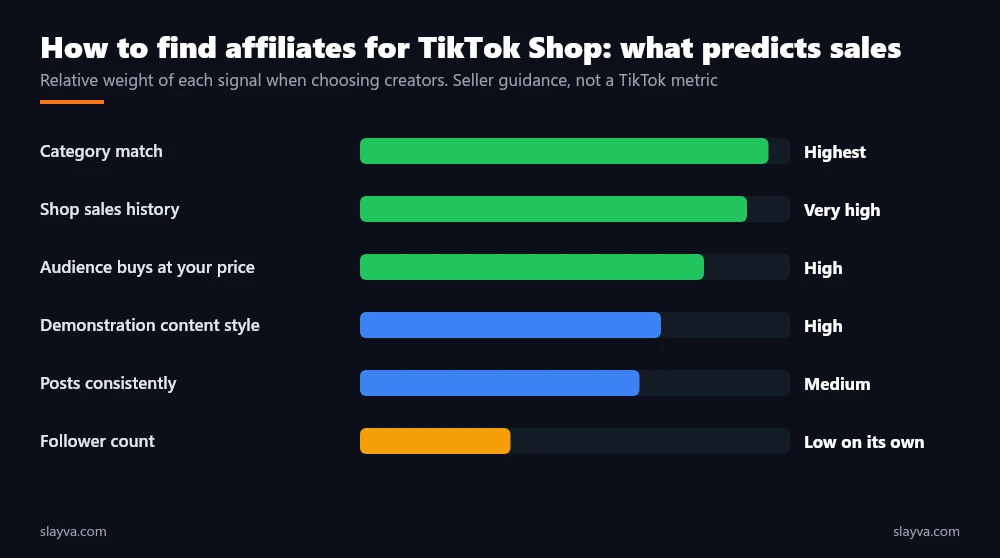
Seller Center lets you browse and filter creators, and it shows data such as category focus, follower count, and past sales performance. Use it to find creators by what their audience buys, not by how many followers they have. These are the signals that matter when you choose creators.
- Category match: they already sell products like yours, to buyers like yours.
- Sales history: a record of shop sales, not only views. Views without sales are entertainment.
- Price point: their audience buys at your price. A creator selling $10 items may struggle with a $90 product.
- Content style: demonstrations and honest reviews convert better for most products than pure entertainment.
- Consistency: they post regularly, so a sample turns into content within weeks, not months.
When sellers ask how to recruit creators on a small budget, the answer is usually smaller creators. Smaller creators with a focused audience are often the best place to start. They respond to invitations, post more reliably, and their audiences trust them. Once a product has proven demand with a few of them, larger creators are easier to recruit because you can show results.
Setting a TikTok Shop Affiliate Commission Rate Your Margin Can Carry
A TikTok Shop affiliate commission rate has to do two things: attract creators and leave you a profit. Start from your margin, not from what other sellers offer. Commission rates vary widely by category, higher where margins are healthy, as in beauty, and lower where they are thin, as in electronics, so there is no single right number.
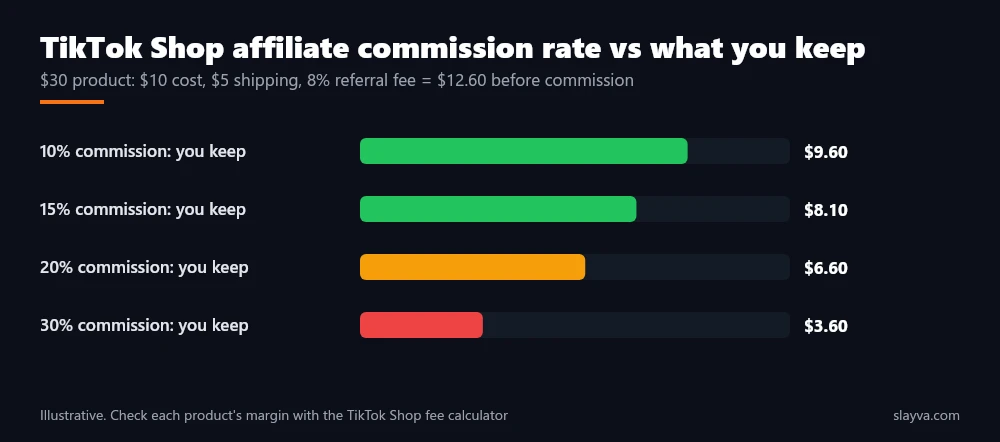
A worked example with illustrative numbers. A product sells for $30. Cost of goods is $10, shipping is $5, and the 8 percent referral fee is $2.40, leaving $12.60 before commission. At a 15 percent commission, the creator earns $4.50 and you keep $8.10. At 30 percent, the creator earns $9 and you keep $3.60. The question is not whether 30 percent attracts creators; it does. The question is whether $3.60 is worth the sale, and whether the product can carry that rate across hundreds of orders.
| Commission | Creator earns | You keep (from $12.60) |
|---|---|---|
| 10% | $3.00 | $9.60 |
| 15% | $4.50 | $8.10 |
| 20% | $6.00 | $6.60 |
| 30% | $9.00 | $3.60 |
A sensible structure is a moderate rate on the open collaboration, enough to be found, and a higher rate reserved for targeted collaborations with creators who have proven they sell. Review rates monthly against results, and use the TikTok Shop fee calculator with the commission field to check the margin on each product.
TikTok Shop Free Samples: Getting Creators to Post
TikTok Shop free samples are the most effective recruiting tool and the easiest place to waste money. Creators can request samples of products in your collaborations, and you decide which requests to approve. Approved samples are shipped to the creator, who is expected to post content.
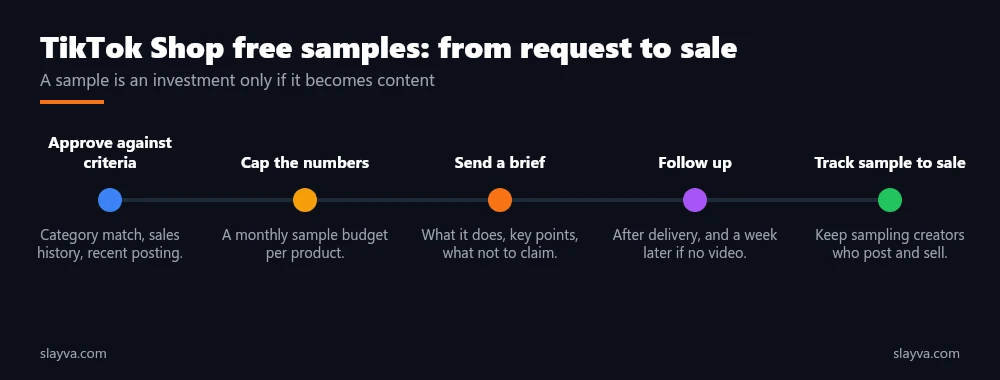
- Approve against criteria. Category match, sales history, and recent posting. Decline accounts with no record of selling.
- Cap the numbers. Set a monthly sample budget per product so requests cannot empty your stock.
- Send a brief with every sample. What the product does, the key selling points, and what not to claim.
- Follow up. A friendly message after delivery, and again a week later if no content has appeared.
- Track sample to sale. Which samples produced videos, and which videos produced sales. Stop sending to creators who do not post.
Samples without follow-up are the most common reason sellers decide creators do not work. The creator received a free product with no brief and no reminder, and it went to the back of the queue. A short brief and one follow-up message change that more than a higher commission does.
How to Find Affiliates for TikTok Shop in Seven Steps
Put together, the process is seven steps. Each one depends on the one before, which is why skipping the early steps is the usual reason a programme stalls.
- Pick the products. Two or three with healthy margins and proven organic sales. Recruiting starts with products creators can succeed with.
- Set the commission from margin. Work back from what is left after the 8 percent referral fee, cost, and shipping.
- Open a collaboration for reach. A TikTok Shop open collaboration at a moderate rate, so creators browsing for products can find yours.
- Shortlist creators by fit. Category, sales history, price point, style, and consistency, filtered in Seller Center.
- Invite the best with a targeted collaboration. A higher rate, a sample, and a brief for your priority products.
- Follow up every sample. One message after delivery and one a week later. This is where most programmes are won or lost.
- Review monthly and repeat. Reward creators who sell, stop sampling those who do not post, and invite the next group.
The steps are simple. What makes them work is doing all seven every month, which is how you keep creators who stay with you.
Briefing Creators Without Risking Your Account
Creators write their own content, but claims they make about your products can lead to deductions on your shop. A good brief protects both of you. Tell creators what the product does, show them how to demonstrate it, and list what they must not say: medical or health claims, guarantees, comparisons that name competitors, or anything your listing does not support. Our guide to TikTok Shop account violations explains how creator claims can cost your shop points, and why the brief is part of account health.
Honest content also reduces returns. A video that oversells brings buyers who return the product, and under the TikTok Shop return policy for sellers the return shipping is usually yours. Accurate enthusiasm sells better over time than exaggeration.
Preparing for the Orders Creators Bring
The best outcome of an affiliate campaign is also the riskiest: a video that takes off and brings in a week’s orders in a day. Before you approve a wave of samples or launch a targeted collaboration, check stock, packing capacity, and handling time. Late dispatch during a spike is the fastest way to lose features just when the product is selling. For fast-moving creator products, Fulfilled by TikTok can remove that risk, as our guide to Fulfilled by TikTok vs seller fulfilled explains.
Affiliates and Ads Together: Recruit Creators Before You Advertise
Creators and ads work best in sequence. Affiliate content proves which products sell and produces a library of videos. Those videos then become the creative that TikTok’s GMV Max campaigns use to scale the products that work. Our guide to how to run TikTok Shop ads covers the paid side. Building a creator base first usually makes advertising cheaper later.
A Four-Week Plan to Start
- Week 1: choose two or three products with healthy margins, set open collaboration rates, and write a one-page brief.
- Week 2: shortlist 20 to 30 creators by category and sales history, and send targeted invitations with samples to the best ten.
- Week 3: follow up on every sample, answer creator questions quickly, and check stock against expected demand.
- Week 4: review which creators posted and which videos sold. Raise commission for proven creators, stop sampling non-posters, and invite the next group.
Repeat monthly. Within a few cycles, you will know which creators fit your products, and you will have a core group of creators who post reliably.
Common Mistakes When Recruiting TikTok Shop Affiliates
- Choosing by follower count. Audience fit and sales history matter more.
- Setting commission by guesswork. Work it back from margin after the referral fee.
- Approving every sample request. Set criteria and a monthly cap.
- No brief, no follow-up. The two cheapest ways to turn samples into content.
- Ignoring capacity. A successful video with no stock or packing plan costs account health.
Frequently Asked Questions About TikTok Shop Affiliates
Where do I find creators for my TikTok Shop?
In the affiliate section of Seller Center, which lets you browse and filter creators by category, audience, and sales performance. That is the starting point for how to find affiliates for TikTok Shop; creators can also find your products through open collaborations.
What is the difference between open and targeted collaboration?
A TikTok Shop open collaboration makes products available to any eligible creator at one commission rate. A TikTok Shop targeted collaboration is an invitation to specific creators, usually at a higher rate and often with samples.
What commission should I offer TikTok Shop creators?
A TikTok Shop affiliate commission rate your margin can carry after the 8 percent referral fee, product cost, and shipping. Rates vary by category; set a moderate open rate and reserve higher rates for creators who have proven they sell.
Should I send TikTok Shop free samples?
Yes, to creators who match your criteria, with a brief and a follow-up. Cap the number per product each month and stop sending to creators who do not post.
Is this the same as the TikTok Shop affiliate programme for creators?
It is the same programme seen from the other side. This guide covers what sellers set up; our affiliate programme guide covers how creators join and earn.
Can creator videos cause problems for my shop?
Yes. Claims creators make about your products can lead to deductions on your shop and to returns. A clear brief on what may and may not be claimed prevents most of it.
How long before affiliates produce sales?
Expect a few weeks: samples have to arrive, creators have to post, and videos need time to find an audience. A four-week cycle of invite, sample, follow up, and review is a practical rhythm.
Want creators selling your products?
We set commission plans from your margins, recruit creators by audience fit and sales history, manage samples with briefs and follow-up, and schedule creator pushes against your stock and dispatch capacity.
Conclusion
How to find affiliates for TikTok Shop comes down to fit, margin, and follow-through. Use an open collaboration for reach and targeted collaborations for your best products and proven creators. Choose creators by what their audience buys, not by follower count. Set commission from the margin left after the 8 percent referral fee, product cost, and shipping. Approve samples against criteria, brief every creator, follow up, and track which samples become sales. Prepare stock and dispatch before a push, and the orders creators bring will build the shop instead of straining it.
For the creator side of the programme, see our affiliate programme guide. For products worth promoting, see our winning products guide. TikTok’s Seller University publishes the current affiliate rules. More TikTok Shop guides are in the blog library.

Usman Malik
All posts by Usman MalikNeed this handled for you?
TikTok Shop Affiliate Management
Creators recruited and commissions managed.
See the serviceTikTok Shop Management
Listings, creators, ads and operations.
See the service- Have this problem now? TikTok Shop account health violations