
Introduction: Two Platforms, One Real Question
Here is the situation a lot of new sellers find themselves in right now. You have a product, a limited budget, and two very loud camps online telling you completely opposite things about TikTok Shop vs Shopify. One group swears TikTok Shop is printing money for anyone who figures out creator partnerships. The other group insists Shopify is the only legitimate way to build a real brand you actually own.
Both are partially right. That is the honest and slightly frustrating truth.
What nobody is saying clearly enough is that TikTok Shop vs Shopify is not really a competition between two similar things. They make money in completely different ways, for different types of sellers, at different stages of a business. So the question is not which platform is objectively better. The question is which one fits how your specific customer actually discovers and buys products right now.
I have spent time pulling real numbers, talking to sellers running both platforms, and watching what is actually moving in 2026. This is not a comparison that ends with a shrug and “it depends.” By the end of this article, you will have a clear picture of where to start and why.
“The platform that makes you more money is not the one with the lowest fees. It is the one that matches how your customer discovers products.”
That one reframe changes the entire TikTok Shop vs Shopify conversation. Let us get into it.
What TikTok Shop vs Shopify Actually Means in Practice
Before comparing them fairly, you need to understand what problem each platform was designed to solve. Most content online glosses over this and jumps straight to fee charts. That is the wrong starting point.
Shopify is ecommerce infrastructure. It gives you a standalone online store, a checkout system, inventory management, and access to hundreds of third-party integrations. You build the store. You bring the traffic. You own the customer data. You control everything from the landing page to the post-purchase email sequence. That ownership is Shopify’s biggest strength and also its steepest challenge for sellers who are just starting out. According to Shopify’s official platform overview, the platform powers over 1.75 million businesses globally, which tells you the infrastructure is battle-tested.
TikTok Shop is social commerce built directly inside the TikTok app. Products live on a platform where over 1.5 billion people are already spending hours each day watching content. Shopping is baked into the scroll. A creator posts a video, a viewer taps the product link without ever leaving the app, and the order is placed in seconds. Discovery happens through content, not through ads you separately fund. You can review TikTok Shop’s seller policies and category guidelines directly on the TikTok Shop Seller Center.
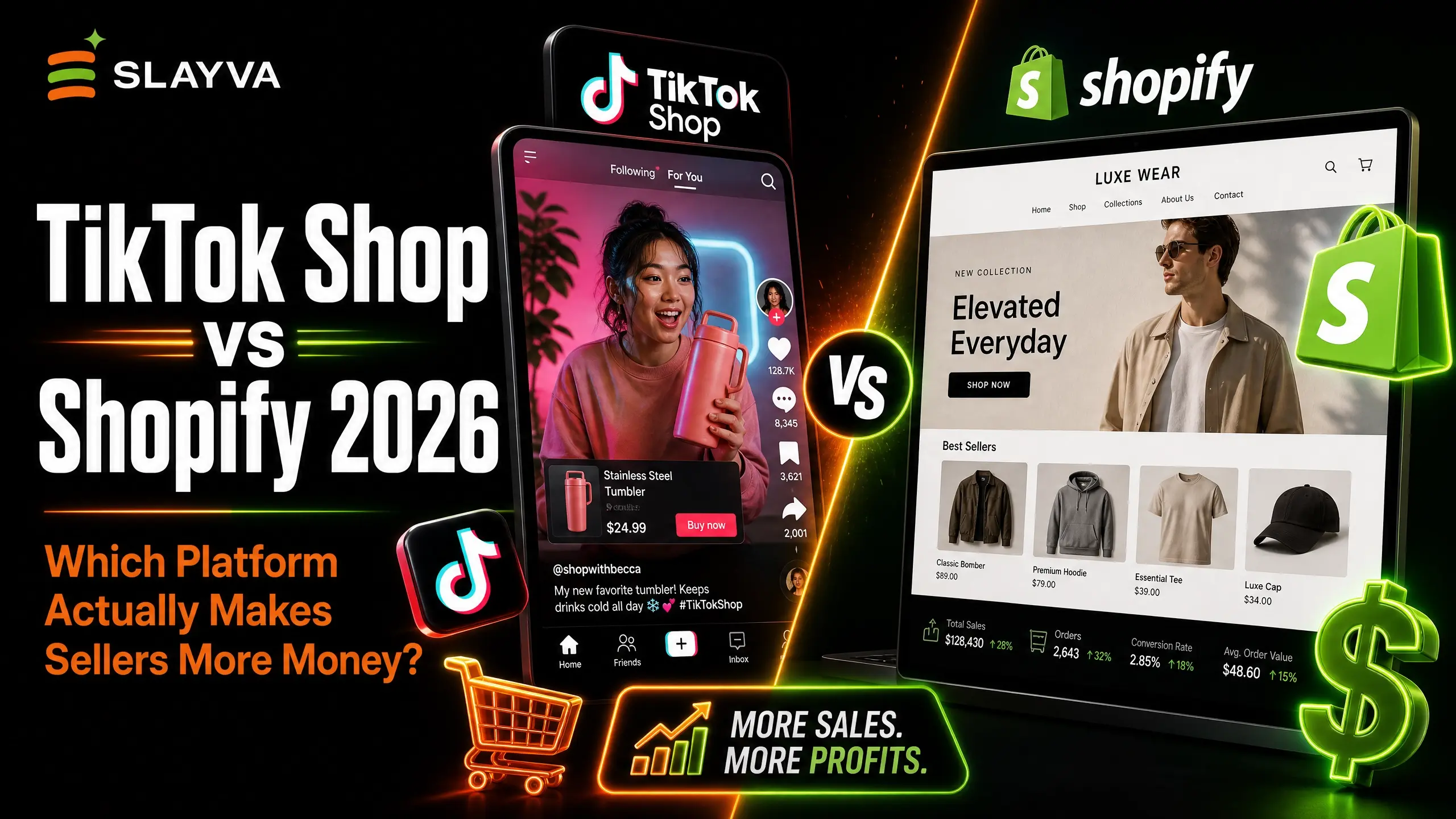
These are fundamentally different models. TikTok Shop vs Shopify is really a question of rented audience versus owned infrastructure.
TikTok Shop vs Shopify Fees and Profits Compared 2026
This is where most comparison articles get lazy and just list fee percentages without any real context. Let us be more useful than that.
Shopify Fees Breakdown
Shopify’s pricing structure in 2026 looks like this:
| Plan | Monthly Cost | Transaction Fee (without Shopify Payments) |
|---|---|---|
| Basic | $39/month | 2% |
| Shopify | $105/month | 1% |
| Advanced | $399/month | 0.5% |
| Starter | $5/month | 5% |
You can review the current plan details on the official Shopify pricing page. On top of the monthly fee, factor in apps. A basic functional Shopify store with email marketing, a review tool, and an upsell app runs roughly $80 to $150 per month in app costs before you sell anything. Then add paid traffic. A beginner running Meta ads at $30 per day is spending around $900 a month just to drive visitors who may or may not convert.
The real cost to operate Shopify as a new seller in 2026 is closer to $1,200 to $2,000 per month before product and fulfilment costs. That is not a knock on the platform. It is just honest math that most Shopify success stories skip over.
TikTok Shop Fees Breakdown
TikTok Shop charges a referral fee that varies by product category, typically ranging from 2% to 8%, with most categories sitting around 6% in 2026. There is no monthly platform subscription. You do not pay to list products.
The real cost on TikTok Shop shows up in the affiliate commissions you offer creators. Most products gaining real traction on TikTok Shop run affiliate rates between 10% and 20% to motivate creators to produce content. On a $35 skincare product, that means offering creators roughly $5.25 per sale on top of the 6% platform cut.
| Cost Type | TikTok Shop | Shopify Basic |
|---|---|---|
| Monthly Platform Fee | $0 | $39 |
| Transaction / Referral Fee | ~6% | 2% (without Shopify Payments) |
| Traffic or Creator Cost | 10–20% affiliate commission | Paid ads ($900–$2,000+/month) |
| App Costs | Minimal | $80–$150/month |
| Break-even Point | Lower | Higher |
On a $35 product with a 10% affiliate rate and 6% referral fee, you are paying $5.60 per sale in platform and acquisition costs on TikTok Shop. On Shopify, that same sale might cost $8 to $15 in ad spend to acquire the customer, plus your platform and app overhead spread across volume. When you put TikTok Shop vs Shopify side by side on a per-unit cost basis, TikTok Shop wins for early-stage sellers almost every time.
TikTok Shop vs Shopify Which Is Better for New Sellers
This is the most practically important version of this question, and new sellers are most at risk of picking the wrong starting point.
The Case for Starting on TikTok Shop
TikTok Shop removes one of the hardest parts of starting an ecommerce business: finding customers. The platform has built-in discovery. A single video from a creator with 50,000 followers can drive hundreds of orders in 48 hours. That kind of reach on Shopify would require weeks of ad testing and thousands of dollars in budget.
If you have a visually interesting product that solves a clear problem, TikTok Shop gives you a genuine shot at validating it without burning capital on ads. List the product, set a competitive affiliate commission, reach out to micro-creators in your niche, and let the content do the selling. According to data shared by eMarketer’s social commerce research, US social commerce sales are projected to exceed $100 billion by 2026, and TikTok is leading that shift.
A kitchen gadget seller shared that they went from zero to $40,000 in their first month on TikTok Shop in early 2026 without spending a dollar on paid ads. Their entire strategy was seeding free samples to 30 creators and offering a 15% affiliate rate. That kind of launch is increasingly common on TikTok Shop and almost unheard of for a cold-start Shopify store.
The Case for Starting on Shopify
TikTok Shop vs Shopify looks different when your product depends on brand identity rather than viral discovery. Custom apparel, personalized gifts, specialty food, or products with a genuine story behind them do not always translate naturally into 30-second content. These categories often perform better when a customer has time to read, browse, and trust.
Shopify also makes more sense if you already have an audience. A newsletter, a YouTube channel, a loyal Instagram following. Any of those can route warm traffic to a Shopify store without depending on an algorithm.
The other major advantage Shopify gives new sellers is customer relationship ownership. Every buyer on your Shopify store is yours. You get their email address, their purchase history, and the ability to reach them again. Every buyer on TikTok Shop is primarily TikTok’s customer. You have limited access to that relationship long-term, which is a real business risk when you are thinking about where TikTok Shop vs Shopify fits into your five-year plan.

Can You Make More Money on TikTok Shop or Shopify in 2026
The answer depends on your time horizon and what you mean by more money.
Short-Term Revenue Potential
In the TikTok Shop vs Shopify race for early revenue, TikTok Shop wins on speed for most physical product categories. The discovery engine combined with creator-driven content can produce real income in days rather than months. For a seller validating a product or generating fast cash flow, TikTok Shop is genuinely hard to beat in 2026.
The platform has been growing its US seller base aggressively, and competition in most niches is still manageable compared to Amazon. Categories like beauty, wellness, kitchen tools, pet products, and home organization are seeing strong sell-through with relatively low creator saturation.
Long-Term Profit and Brand Value
Shopify is the stronger long-term vehicle if you are building a brand. The margin picture improves dramatically as you scale because customer acquisition costs stabilize while your average order value and repeat purchase rate climb. Research from Klaviyo’s ecommerce benchmarks consistently shows that email-driven repeat purchases convert at rates three to five times higher than cold traffic. Shopify is built to capture and leverage that.
A brand generating $500,000 per year on Shopify with a strong email list and a 25% repeat customer rate is worth considerably more than a TikTok Shop seller doing the same volume entirely dependent on fresh creator content. The Shopify business has equity. The TikTok Shop operation has exposure.
When you think about TikTok Shop vs Shopify through the lens of long-term business value, Shopify is not even close.
The Hybrid Approach Most Smart Sellers Are Running
Here is what the more experienced operators are doing in the TikTok Shop vs Shopify debate in 2026: they are not choosing. They use TikTok Shop to generate volume and validate products at low upfront cost. Then they move repeat buyers toward their Shopify store where they control the experience and own the data.
The mechanic is simple. Include a small card in your TikTok Shop packages offering a discount code for future purchases at your Shopify store. It builds your owned customer base without requiring a big separate marketing budget.
Should I Sell on TikTok Shop or Shopify in 2026: A Practical Decision Guide
Rather than hedging further, here is a direct framework based on the most common seller situations.
Start on TikTok Shop if:
Your product demonstrates clearly in a short video. You have a limited budget and cannot fund months of paid ad testing. Your product has mass appeal rather than niche-specific demand. You are comfortable with a faster, scrappier pace and do not need a polished operation from day one. You want to validate demand before committing to building out a full brand.
Start on Shopify if:
You are building around a brand story or aesthetic that requires trust to convert. Your product is higher-ticket and requires more consideration before purchase. You already have an audience you can direct to a store. You are planning subscriptions, bundles, or product configurations that need a full ecommerce backend. You want to own your customer data from day one and are willing to invest in traffic to build that long-term asset.
Run both if:
You have at least a few months of selling experience, a proven product, and the bandwidth to manage two channels. In that scenario, TikTok Shop vs Shopify stops being a competition and becomes a complementary system.
TikTok Shop vs Shopify: Platform Features That Actually Matter
| Feature | TikTok Shop | Shopify |
|---|---|---|
| Built-in traffic | Yes, via For You Page | No |
| Customer data ownership | Limited | Full |
| Monthly fees | None | $39–$399+ |
| Native affiliate/creator tools | Yes, built-in | Requires third-party apps |
| Brand customization | Minimal | Extensive |
| Checkout experience | In-app, seamless | Fully customizable |
| Email and SMS marketing | Limited | Robust native and app support |
| Repeat customer tools | Weak | Strong |
| International selling | Expanding | Well established |
| Platform dependency risk | Higher | Lower |
TikTok Shop vs Shopify: The Things Nobody Talks About Enough
Creator Relationships Are the Real Moat on TikTok Shop
The sellers consistently winning on TikTok Shop in 2026 are not just listing products and hoping. They are building real relationships with creators. They respond fast, offer fair rates, send products that actually work as described, and treat creators like business partners. The sellers who are struggling on TikTok Shop almost always have the same problem: they reached out to creators with generic products and low commissions, got ignored, and concluded TikTok Shop does not work. The platform works. Their approach did not.
If you want to understand how the TikTok Shop affiliate ecosystem actually functions, the TikTok Shop Creator Marketplace documentation is worth reading through before you list a single product.
Shopify’s Real Advantage Is the Email List, Not the Store
Ask any Shopify seller with two or more years of experience where their most reliable revenue comes from. Almost all of them will say email. The store is the front door. The email list is the actual business.
A list of 10,000 past buyers is an asset you can generate revenue from any time you launch something new, run a promotion, or need to fill a slow month. Tools like Klaviyo and Omnisend integrate directly with Shopify and are what most serious sellers use to turn that list into predictable income. TikTok Shop simply does not give you that kind of leverage over your own revenue.
TikTok Shop vs Shopify: A Real Profit Scenario
You are selling a $45 silicone kitchen utensil set. Your landed cost including product and shipping is $12. Gross margin before platform costs is $33.
On TikTok Shop:
- 6% referral fee: $2.70
- 15% creator affiliate commission: $6.75
- Total platform and acquisition cost per unit: $9.45
- Net profit per unit: $23.55
- Net margin: 52%
On Shopify with paid traffic:
- Basic plan fee amortized at 100 sales per month: $0.39
- Shopify Payments processing (2.9% plus $0.30): $1.61
- Estimated Meta ad cost per conversion: $10
- Total cost: $12
- Net profit per unit: $21
- Net margin: 47%
In this scenario, TikTok Shop produces a slightly better margin with zero fixed monthly costs. On Shopify, however, once your email list generates 30% of sales at near-zero acquisition cost, your blended margin improves significantly over time. That is the long-term argument for Shopify in the TikTok Shop vs Shopify conversation, and it is a compelling one once you hit meaningful scale.
Conclusion: Which Platform Actually Makes Sellers More Money
Bringing it back to the core question of TikTok Shop vs Shopify: here is the direct answer.
If you are a new seller with a physical product that performs well on video and a limited budget to start, TikTok Shop is the most accessible path to revenue in 2026. The built-in discovery, the native creator affiliate ecosystem, and the absence of a monthly fee make it genuinely forgiving for sellers who are still figuring things out. You can validate a product without betting your savings on paid advertising.
If you are building a brand with staying power, a product line with depth, or a business you want to eventually scale or sell, Shopify is where that equity lives. The customer relationships, the email list, the brand experience. None of that exists in a meaningful way on TikTok Shop.
The smartest operators in 2026 are not picking a side in the TikTok Shop vs Shopify debate. They are using TikTok Shop to fund and validate while building toward Shopify ownership in parallel. That is not a compromise answer. It is just what the most profitable sellers are actually doing.
Pick the platform that matches where you are right now. Prove the product. Generate revenue. Then build the infrastructure that will outlast any single platform. That is the move.
FAQ: TikTok Shop vs Shopify 2026
Is TikTok Shop better than Shopify for beginners?
For most beginners selling visually demonstrable physical products, TikTok Shop has a lower barrier to entry and lower upfront costs. You do not need an existing audience to make sales. Shopify has a steeper ramp but gives you more control and long-term equity.
Can you run TikTok Shop and Shopify at the same time?
Yes, and many successful sellers in 2026 do exactly this. TikTok Shop drives discovery and volume while Shopify handles repeat customers, brand building, and owned customer data. The two work well together once you have bandwidth to manage both.
What are TikTok Shop’s referral fees in 2026?
TikTok Shop referral fees typically run between 2% and 8% depending on category, with most sitting around 6%. There is no monthly subscription fee. Your main additional cost is the creator affiliate commission you set, which competitive sellers typically put between 10% and 20%.
Does Shopify give you access to your customer data?
Yes. Shopify gives you full access to customer emails, order history, and purchase behavior. You can export it at any time. TikTok Shop provides much more limited access to buyer contact information, which is one of the most significant practical differences in the TikTok Shop vs Shopify debate.
Which platform has better profit margins in 2026?
In the early stages, TikTok Shop often produces better margins because you avoid paid ad costs. At scale, Shopify sellers with strong email lists and repeat purchase rates typically see better blended margins over time.
Is TikTok Shop safe to build a business on long-term?
TikTok Shop carries regulatory uncertainty in some markets including the US. That risk is real and worth factoring into your planning. Running both platforms, or using TikTok Shop to fund a Shopify buildout, hedges against that dependency.
How do I get creators to promote my TikTok Shop products?
Set a competitive affiliate commission, enable your TikTok Shop affiliate program in the seller center, and directly reach out to micro-creators in your niche with a free sample offer. Creators with 10,000 to 100,000 followers often convert better than large accounts and are more accessible when you are starting.
What products sell best on TikTok Shop in 2026?
Beauty and skincare, kitchen gadgets, wellness products, pet accessories, home organization, and trending fashion accessories continue to perform strongly. Products that demonstrate clearly in under 60 seconds and solve an obvious problem consistently outperform on TikTok Shop.
Can TikTok Shop replace Shopify entirely?
Technically yes for pure product sellers. But from a business-building standpoint, relying entirely on TikTok Shop means you own very little. Platform changes, policy shifts, or algorithm updates can cut your revenue overnight. Most experienced operators use TikTok Shop as a channel, not a foundation.
Should I sell on TikTok Shop or Shopify if I have under $500 to start?
Under $500, TikTok Shop is the more practical choice. No monthly fees, no paid ad budget required, and creator-driven content can generate sales faster than almost any other starting strategy at that budget level.