
Introduction
I almost shut down my first store because of something embarrassingly simple.
Traffic was decent. The photos looked clean. Prices made sense. People landed on a product page, scrolled for three seconds, and bounced. I could not figure out the problem.
Then a friend asked me a question that changed everything. “Would you buy from this page?”
I looked at my own product description and realized the answer was no. It was boring. It sounded like a robot wrote it. It gave me specs I did not care about and left out the one thing I actually wanted to know: will this work for me?
I stopped treating product descriptions that convert as an afterthought that day. I started treating them as the sales tool that closes the deal.
“Most store owners obsess over ads and traffic. They ignore the page that decides whether someone buys. Your product description costs you money every time someone reads it and leaves unimpressed.”
Good product descriptions that convert are not about fancy copywriting. They are about understanding who is reading. They give people exactly what they need to feel confident enough to click “add to cart.” Writing product descriptions that convert is a skill you can learn, not a talent you are born with.
Here is everything I know about writing product pages that sell. Every example and framework here has generated real revenue for real Shopify stores. These are product descriptions that convert in the real world, not in theory.
Why Most Product Descriptions Do Not Do Their Job
Let me tell you what is probably on your product pages right now.
You started with the manufacturer’s description. You tweaked a sentence or two. You added a bullet list of features. You called it done.
I understand why. Writing 100 unique product descriptions is a grind. But here is the problem. That approach puts you in direct competition with every other store selling the same thing. Same words. Same claims. Same boring text. None of these are product descriptions that convert.
Manufacturer descriptions are written for retailers. They are not written for customers. They are loaded with jargon and technical specs. They mean nothing to the person trying to decide if they should spend their money.
Then there is the formatting. Huge blocks of text. Nobody reads those on their phone during a lunch break. If your description looks like a homework assignment, people skip it. You need product descriptions that convert, not product descriptions that overwhelm.
The fix is not working harder. The fix is working differently.
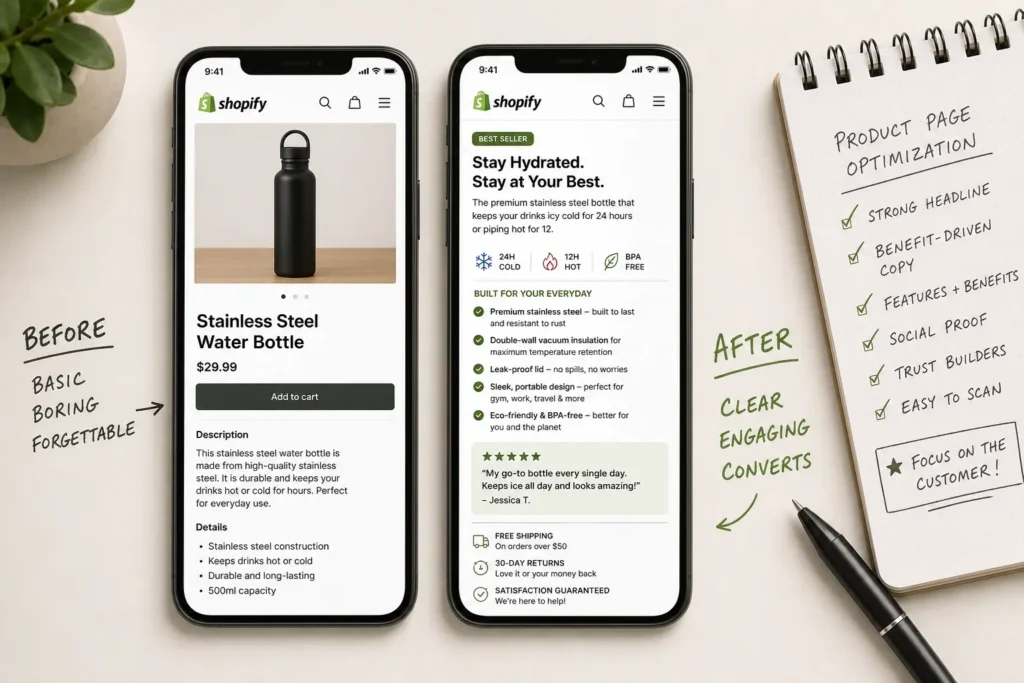
Here is a quick look at what separates product descriptions that convert from descriptions that fail:
| Element | Generic Description | Converting Description |
|---|---|---|
| Opening | “Introducing our new moisturizer” | “Your skin felt fine this morning. Now it is 3pm and your cheeks are tight.” |
| Features | “10,000mAh battery capacity” | “Powers your phone for 3 full days without hunting for an outlet” |
| Objections | Ignored or buried in fine print | Addressed directly in a dedicated Q&A section |
| Formatting | Long paragraphs, dense text | Short paragraphs, bold key phrases, bullet points |
| Voice | Corporate, formal, generic | Conversational, specific, human |
What Actually Makes Someone Buy
Nobody wakes up thinking “I need to read some product descriptions today.”
They show up on your page because something bothered them. Their skin has been breaking out for weeks. They are planning a trip and want to look good in photos. Their old gadget died and they need a replacement.
They are asking one question. “Will this solve my problem?”
Your job is not to list features. Your job is to answer that question. Answer it so clearly that buying feels like the obvious next step. This is what product descriptions that convert do differently.
The difference between descriptions that convert and descriptions that do not comes down to language. Use the words your customers use. Talk about the outcome they want. Make them feel understood before you ever ask for the sale. The best product descriptions that convert read like a conversation, not a sales pitch.
“People buy when they feel understood. Your product description is either making that connection or losing it. There is no middle ground.”
Nielsen Norman Group has done extensive research showing that people respond to content written in their own vocabulary. We trust people who sound like us. This is how brains work. This is the psychology behind product descriptions that convert.
The Framework I Use for Every Product Page
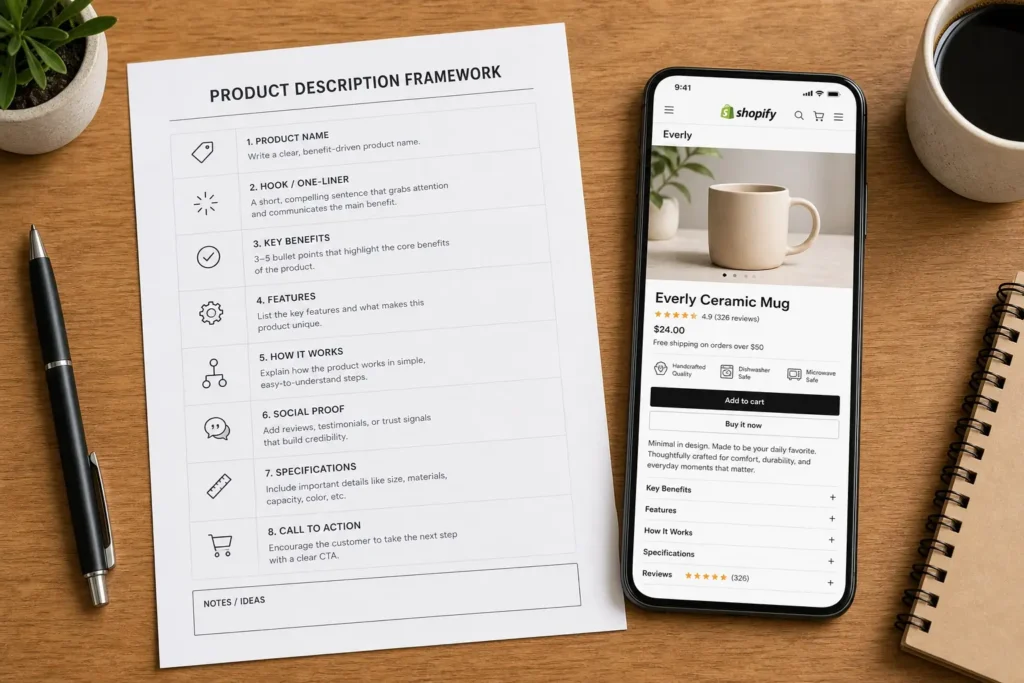
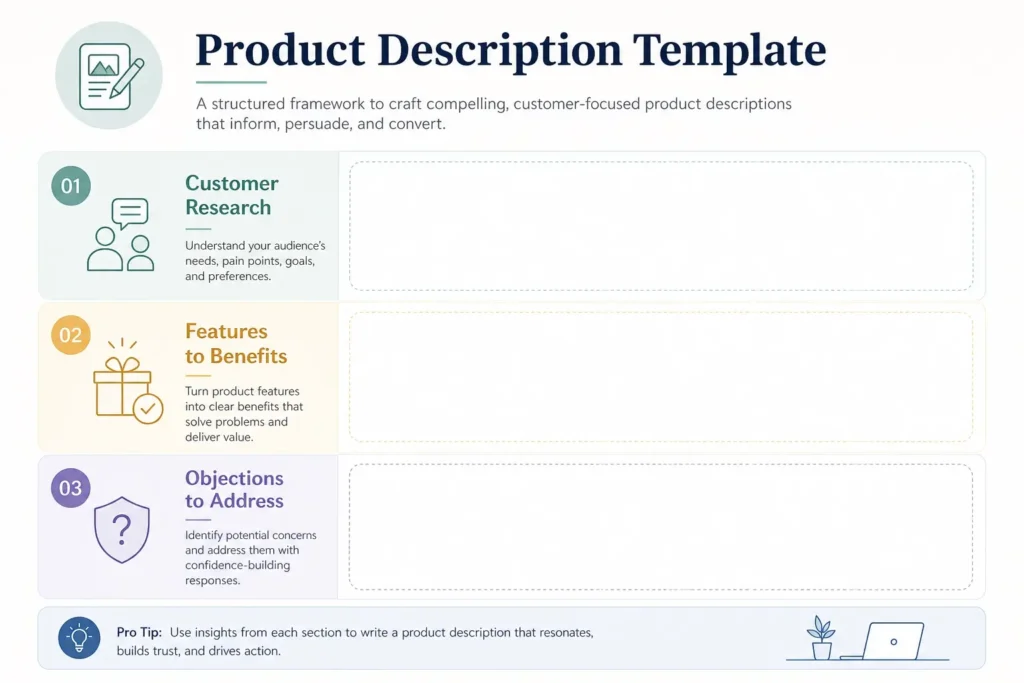
After testing hundreds of variations, I landed on a structure that works across categories. It forces you to think about the right things in the right order. This framework produces product descriptions that convert regardless of what you sell.
Start With Who, Not What
Before typing a single word, answer three questions.
Who is this for? What were they doing right before they started searching for this product? What do they need to believe before they will feel confident buying?
If you cannot answer those questions, stop. Find five reviews for similar products. Read what people actually wrote. Pay attention to the exact phrases they use. This research is the foundation of product descriptions that convert.
The Opening Line Does the Heavy Lifting
Your first sentence either earns attention or loses it.
Generic openings do not work. Skip things like “Introducing our new” or “The perfect addition to your.” These are not product descriptions that convert. They are product descriptions that get scrolled past.
Open with their problem. “You have tried three moisturizers and your face still feels tight by noon.”
Or open with their desire. “The difference between good coffee and great coffee comes down to something most people ignore completely.”
Now they are nodding. Now they are reading. This is how product descriptions that convert earn attention in the first three seconds.
Features Are Fine. Connect Them to Outcomes
Every time you mention a feature, ask yourself “so what?”
Here is how this looks across different product types. This is the translation process that turns ordinary descriptions into product descriptions that convert:
| Feature | Weak Description | Converting Description |
|---|---|---|
| Waterproof jacket | “Waterproof membrane” | “You walk home in unexpected rain and arrive completely dry” |
| 1200 watt blender | “Powerful 1200W motor” | “Pulverizes frozen fruit into smoothie consistency in 30 seconds” |
| Organic cotton shirt | “100% organic cotton” | “No chemicals against your skin. Soft natural comfort all day” |
| Sapphire crystal watch | “Scratch resistant glass” | “Short of a diamond, nothing scratches this glass” |
The connection seems obvious to you because you know the product. It is not obvious to someone seeing it for the first time. Make the link explicit. Product descriptions that convert never assume the customer will connect the dots alone.
Handle Doubts Before They Form
Every product category has built-in objections. Clothing has sizing concerns. Electronics have compatibility questions. Skincare has sensitivity worries.
Address these directly. I write a section called “What You Might Be Wondering” and answer the three most common concerns.
It feels vulnerable to bring up potential problems. But Baymard Institute’s ecommerce research shows what you would expect. When shoppers’ questions go unanswered, they leave. Addressing concerns builds more trust than pretending they do not exist. Trust is the foundation of product descriptions that convert.
“The moment a customer forms a question you have not answered, they leave. The sale dies in that silence.”
Make Them Imagine Owning It
There is a subtle shift when someone goes from “considering” to “imagining.” Your words can trigger that shift.
Describe what it feels like to use the product. How heavy is the mug in your hand? What does the candle make your living room smell like on a Sunday morning? How does the jacket sound when you zip it up?
Sensory details create mental ownership. Once someone can imagine the product in their life, buying feels like completing something rather than starting something new. Product descriptions that convert use sensory language to create this shift.
Format for How People Actually Read
Nobody reads product pages word for word on their first visit. They scan. They scroll. They look for the specific bit of information that matters to them.
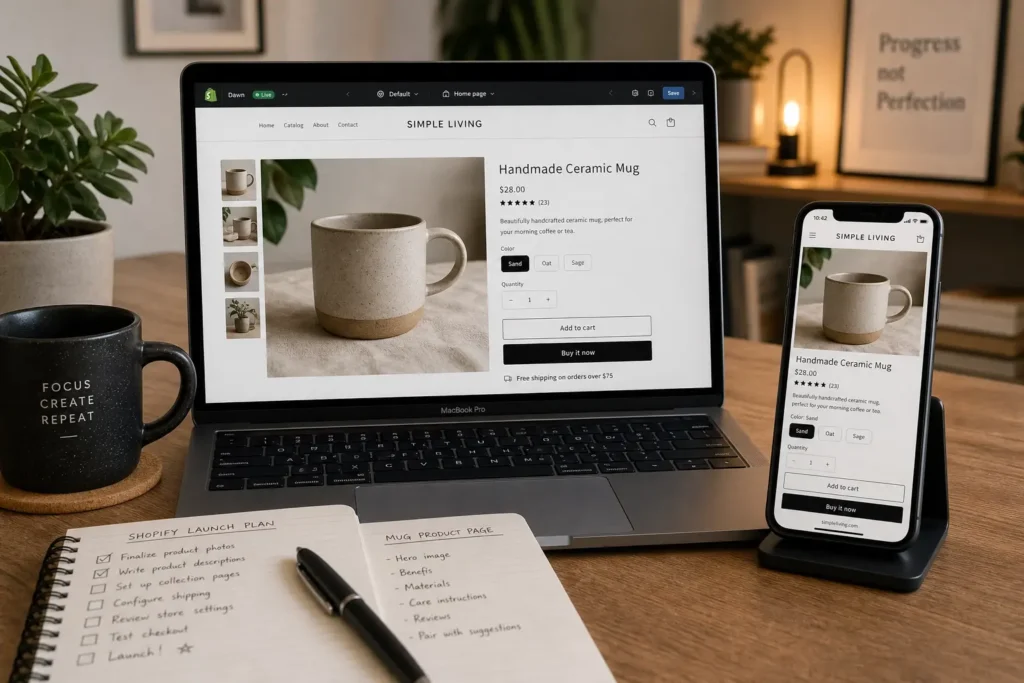
Short paragraphs. White space. Bold on the key phrases someone might be scanning for. If someone can find what they need in ten seconds, they will stay. If they have to hunt, they leave.
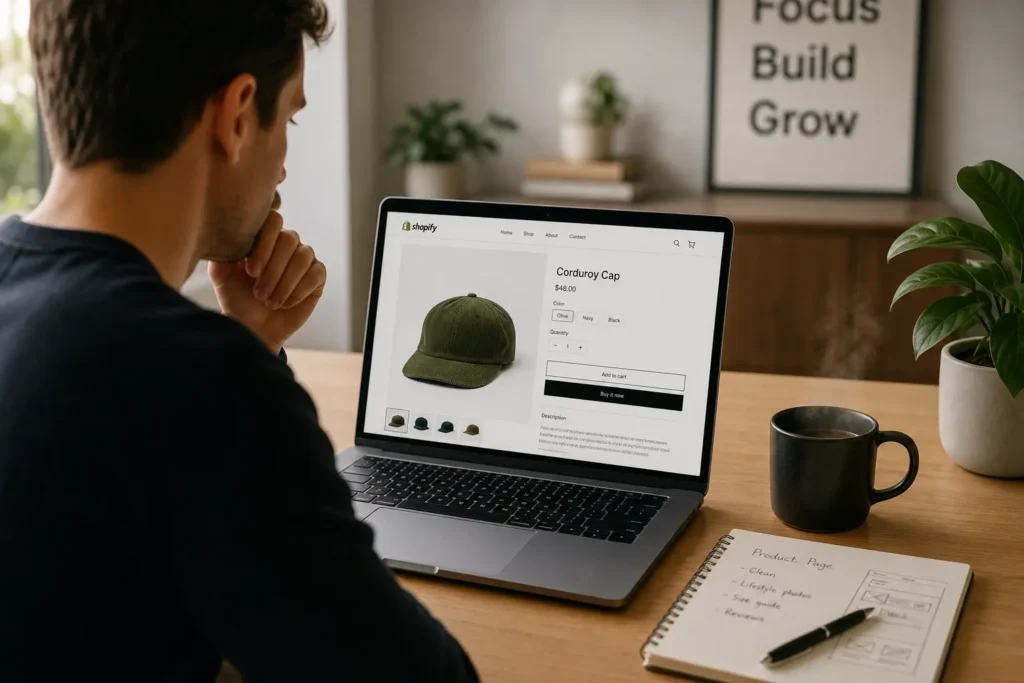
Test this on your phone. Not your desktop. Your phone. If you would not read your own description while waiting for coffee, fix it. Product descriptions that convert are formatted for mobile first.
Real Examples You Can Steal From
Sometimes it helps to see examples. Here are product descriptions that convert, with notes on why they work.
For a Skincare Product
“Your skin felt fine this morning. Now it is 3pm and your cheeks are tight. Your forehead looks shiny. You are pretty sure that new redness was not there yesterday.
You have cycled through drugstore brands and department store creams. Some helped briefly. Most sat on top of your skin doing nothing.
Our moisturizer has what your moisture barrier needs: ceramides, squalane, and colloidal oatmeal. It has nothing it does not need. No fragrance. No essential oils. No activities that conflict with your other products.
What to expect: skin that feels comfortable all day. Less random redness. A more even texture. Some people notice the difference in three days. Most by two weeks.
What you might be wondering:
Is this right for sensitive skin? Yes. It was dermatologist tested on sensitive skin specifically. Zero fragrance. Zero essential oils.
How long does one bottle last? About two months with daily use. A little goes further than you think.
What if it does not work for me? You have 60 days to try it. If it is not for you, we will refund the full price.
Add to cart. Use it for a month. If your skin is still acting up, send it back.”
Why this works: It reads like a person talking. It names specific frustrations. It explains what is NOT in the product. The Q&A section answers the exact questions someone with sensitive skin would have. The guarantee removes risk without feeling pushy. These are the hallmarks of product descriptions that convert.
For a Watch
“Your grandfather’s watch meant something. He checked it before walking your mother down the aisle. He reached for it every morning for forty years. It was not a gadget. It was part of who he was.
We make watches for that kind of relationship.
The movement is Japanese quartz. It keeps time within seconds per month for decades. The leather band is full grain Italian. It darkens and softens in ways unique to how you wear it. The glass is sapphire crystal. Short of a diamond, nothing scratches it.
This is not a smartwatch. It will not buzz with notifications. It will not be obsolete when a new chip comes out. It will tell you the time and look better than anything plastic.
What you might be wondering:
How long does the leather last? Years with normal wear. It ages. That is the point.
Does it work for smaller wrists? Yes. We include free resizing before we ship. Tell us your wrist size at checkout.
What if I do not like it once I see it? Returns within 30 days. No questions.
15,000 people switched from disposable quartz watches to something that ages with them.”
Why this works: It sells values. It acknowledges what the product is not, which builds trust. The opening story creates emotion before any mention of specifications. Storytelling is a signature of product descriptions that convert.
“Great product descriptions do not describe products. They describe the person your customer becomes after using what you sell.”
Quick Answers to Questions I Get Asked Constantly
Can I use AI for this?
You can use it for a first draft. You will need to edit anything it produces. AI tends toward generic language. Generic does not convert. Feed it your customer research and your voice guidelines. Then rewrite. AI alone will not produce product descriptions that convert. Human editing makes the difference.
How long should descriptions be?
Long enough to answer every question. Short enough to stay interesting. For a 15product,maybe100words.Fora150 product, 250 to 400. For purchases over $200, 500 words if they are good words. Nobody complains about helpful information. People complain about fluff. Product descriptions that convert earn their length with value.
What if my products are boring?
Nobody buys boring things. They buy solutions and outcomes. A paper towel holder is not exciting. “Never wrestling with a roll of paper towels while your hands are covered in raw chicken juice” matters to someone. Find the moment your product matters. Write about that. Even boring products can have product descriptions that convert.
Do I need unique descriptions for every variant?
Yes. Google treats duplicate content as a negative signal. A customer looking at the navy version needs to know how it differs from the black version. It does not have to be a complete rewrite. It should be meaningfully different. Each variant deserves its own version of product descriptions that convert.
When should I update my descriptions?
When conversion rates drop. When a product gets questions you did not address. When you learn something new about your customers from reviews. Review your top sellers quarterly. Refresh based on what you have learned. Continuous improvement keeps product descriptions that convert performing well.
What to Do Right Now
You do not need to rewrite your entire store this weekend. Pick three products.
Pick the ones that get the most traffic but have the worst conversion rates. The ones people are interested in but not buying. Read your current description out loud. Ask yourself: does this sound like something I would say to a friend? Does it address the fears someone has before buying? Does it make them feel understood?
Spend twenty minutes on each one. Write the opening like you are talking to one person. Connect every feature to an outcome. Add a section answering the three questions you would have as the customer.
Publish. Wait two weeks. Check if conversion improved.
One of my highest-converting product pages started as a thirty-minute rewrite of a description I had ignored for six months. The product did not change. The photos did not change. The words changed. Sales doubled. That is the power of product descriptions that convert.
“Your product description is the hardest working employee you never hired. It shows up every time someone visits. It never complains. It costs nothing to train. Get it right.”
The stores winning in 2026 are not the ones with the fanciest themes or the biggest ad budgets. They are the ones that figured out something most sellers overlook. People buy when they feel understood.
Give them that feeling. Write product descriptions that convert. Everything else gets easier.
Frequently Asked Questions About Product Descriptions That Convert
How long should a product description be?
The ideal length depends on your product’s price and complexity.
- Simple products (under $30) usually need 100 to 150 words.
- Mid-range products ($30 to $100) typically need 150 to 300 words.
- High-value or complex products (over $100) often require 300 to 500 words.
Instead of focusing on a fixed word count, aim to clearly answer every question a buyer may have.
The real goal is not to meet a word limit, it’s to write product descriptions that convert visitors into customers.
Should I use the same description for different variants?
No. Each variant deserves unique elements. The core description can remain similar. Each variant should highlight color specific details and styling suggestions. Unique descriptions prevent duplicate content issues that harm your SEO performance. Variant specific content helps create product descriptions that convert for every option in your catalog.
How do I write good product descriptions for unexciting products?
Every product solves a problem. Find the emotional connection. A paper clip is not exciting. Never losing an important document matters. A cleaning product is not glamorous. Spending 20 fewer minutes scrubbing every weekend matters. Connect the product to the outcome the customer cares about. Even unexciting products can have product descriptions that convert when you focus on outcomes.
Do product descriptions affect SEO?
Yes. Search engines crawl your description text to understand what you sell. Unique, detailed descriptions with natural keyword inclusion help product pages rank. Duplicate or thin descriptions hurt rankings. Write for customers first. Include relevant search terms naturally. Product descriptions that convert for humans also perform better in search results.
What is the most important element of a product description?
The opening sentence. If your opening does not hook the right customer and communicate immediate relevance, the rest of your description does not matter. Spend disproportionate time crafting compelling openings for every product page. The opening determines whether anyone reads your product descriptions that convert.
How do I know if my product descriptions are working?
Track conversion rate by product page. Monitor bounce rate on product pages. Watch time on page. Measure add to cart rate. Test one element at a time and measure the impact. Customer feedback reveals what information influenced their purchase decision. Use their language in your descriptions. Data confirms which of your product descriptions that convert are performing best.
Should product descriptions include customer reviews?
You can weave in social proof without pasting full reviews. Mention how many customers purchased. Quote a relevant sentence from a review. Include usage statistics. Social proof embedded in your description feels more authentic than isolated testimonial sections. It reinforces your claims without interrupting the flow. The strongest product descriptions that convert blend proof seamlessly into the narrative.