You’re losing sales before your store even loads. And in 2026, that’s a death sentence.
The ecommerce gold rush is over. The era of survival-of-the-fittest is here. With AI shopping agents, voice commerce, and attention spans shorter than a TikTok clip, your platform choice isn’t just “tech infrastructure”, it’s a strategic weapon or a ticking time bomb.
Most entrepreneurs pick WooCommerce because it’s “free.” Or Shopify because it’s “easy.” Then they spend the next two years trapped in a nightmare of slow load times, hidden fees, or developer dependency.
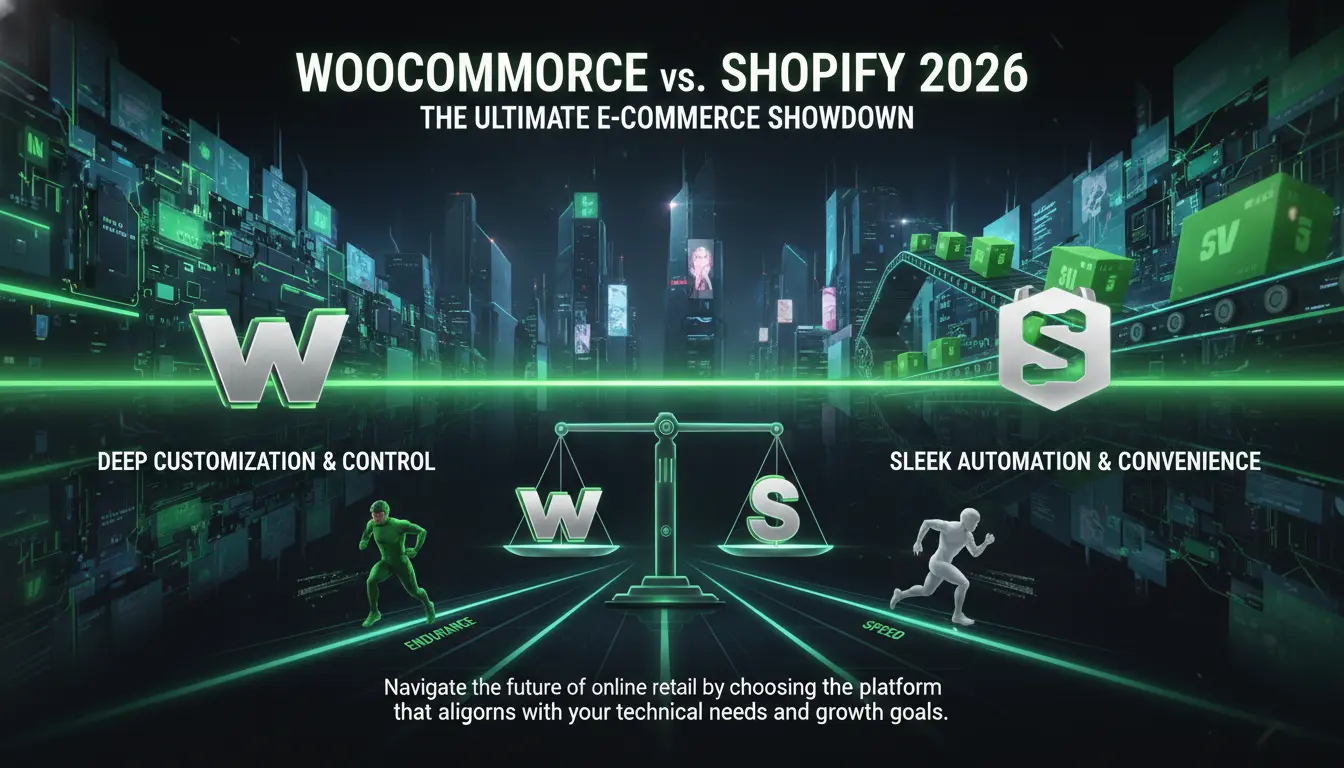
You don’t need more opinions. You need a decision framework. The WooCommerce vs Shopify in 2026 debate has never been more consequential, and by the end of this guide, you’ll know exactly which platform scales your revenue, protects your margins, and survives the AI-driven search landscape. No fluff. No bias. Just conversion-focused truth.
The 10-Second Verdict
Choose Shopify for hands-off scalability, built-in AI commerce tools, and faster time-to-market. Choose WooCommerce for total data ownership, lower long-term costs on large catalogs, and advanced content marketing synergy with WordPress. Shopify wins on ease; WooCommerce wins on control.
“The most expensive platform isn’t the one with a monthly fee. It’s the one that silently kills your conversion rate with 3-second load times and forces you to pay $299/mo just to remove transaction fees. Know your math before you choose.”
The 2026 Landscape Has Changed Everything
Three years ago, the WooCommerce vs Shopify in 2026 debate was about themes and payment gateways. Today? It’s about survival in an AI-first search ecosystem.
According to Google’s 2026 Core Web Vitals update, the algorithm now prioritizes Commerce Experience Signals (CXS). This includes:
- Core Web Vitals (load speed, interactivity, visual stability)
- Structured product data (Schema markup depth)
- Content authority (blog + product integration)
- Mobile-first checkout completion rates
Here’s the kicker: Shopify and WooCommerce deliver these signals in opposite ways.
If you pick wrong, you don’t just lose SEO rankings. You lose your spot in Google’s AI Shopping Graph — meaning your products won’t even appear in conversational search results via Gemini or ChatGPT Shopping.
Data from BuiltWith’s 2026 Ecommerce Market Share Report shows that Shopify now powers 29% of all online stores, while WooCommerce holds 24%. But market share doesn’t mean market fit for your business.
This makes the WooCommerce vs Shopify in 2026 choice more critical than ever. So let’s dismantle the hype and rebuild your decision from the ground up.
Shopify in 2026 – The AI-Powered Fortress
What Shopify Does Better Than Anyone
Shopify has evolved far beyond a “drag-and-drop store builder.” In 2026, it’s a closed-loop commerce operating system.
Out-of-the-Box Page Speed
Shopify’s infrastructure now includes automatic image CDN optimization, edge computing, and native AMP for product pages. Average load time: 0.9 seconds according to Shopify’s 2026 Performance Benchmarks.
For context, 53% of mobile users abandon a site that takes over 3 seconds. Shopify eliminates that risk instantly.
Shopify Sidekick – Your AI Assistant That Actually Works
Sidekick (now fully live in 2026) isn’t a gimmick. It analyzes your store’s conversion data, suggests product bundle optimizations, and even rewrites meta descriptions for better rankings. You don’t need an SEO agency for basic ranking tasks.
The “Everything Included” Tax
No hosting security patches. No backup plugins. No PHP version anxiety. You pay $39–$399/month, and Shopify handles PCI compliance, automatic updates, and 24/7 security monitoring.
Verdict: Shopify is for founders who want to focus on marketing and products, not server logs.
The Real Cost of Shopify
That $39/month store? It quickly becomes $79 + transaction fees unless you use Shopify Payments.
- Transaction fees (without Shopify Payments): 2.9% + $0.30 + an extra 0.5–2% penalty
- App creep: The average Shopify store spends $215/month on apps (reviews, upsells, subscriptions)
- Long-term lock-in: Migrating away from Shopify is painful. Their walled garden owns your customer data structure
“Shopify’s real genius isn’t software, it’s making you dependent on their app ecosystem. Every ‘simple fix’ adds $19/month. Before you know it, you’re paying $500/mo for what WooCommerce does natively.”
When Shopify Wins
- You’re launching a new brand and need live sales within 7 days
- Your catalog has fewer than 5,000 SKUs
- You have zero interest in managing hosting or databases
- You want built-in AI tools for SEO and merchandising
When Shopify Loses
- You sell complex products requiring custom filtering (e.g., industrial parts, real estate, configurable furniture)
- You need advanced content marketing (blog + product SEO synergy)
- You hate recurring fees and prefer paying for performance
For more Shopify SEO guidance, visit Shopify’s official SEO guide.
WooCommerce in 2026 – The Open-Source Powerhouse
WooCommerce’s Unfair Advantages
WooCommerce is not a platform. It’s a WordPress plugin that transforms any site into a store. That distinction matters more than ever in the WooCommerce vs Shopify in 2026 conversation.
Total Data Ownership
In 2026, data privacy laws have tightened globally (the US federal privacy act, stricter GDPR enforcement). With WooCommerce, customer data lives on your server. You control analytics, email lists, and retargeting pixels completely. Shopify shares aggregated data with its merchant network (opt-out is buried).
Lower TCO for Large Catalogs
A store with 50,000 products on Shopify would need the $2,000/mo “Shopify Plus” plan for adequate backend performance. WooCommerce, on a $100/mo dedicated cloud server (Cloudways, Kinsta), handles 200,000+ SKUs without blinking.
You pay for hosting, a premium theme ($59 one-time), and WooCommerce SEO plugins like Rank Math or Yoast ($89/year). That’s it.
Unmatched SEO Content Synergy
Here’s the hidden weapon most people miss: Shopify’s blogging engine is weak. It lacks proper internal linking suggestions, category taxonomy depth, and dynamic product-to-content relationships.
WooCommerce + WordPress = The ultimate SEO stack.
Write a blog post about “best hiking backpacks for winter.” Dynamically pull product grids, comparison tables, and schema markup from your catalog automatically.
Use Rank Math SEO to optimize every product variant with 10x more granularity than Shopify allows.
That’s why brands like Kinsta, Astra, and countless niche ecommerce sites dominate organic traffic. They treat products as content, not just SKUs.
True Multilingual & Multi-Currency
Shopify requires paid apps for serious internationalization (often $29/mo each). WooCommerce, with free plugins like Loco Translate and WooCommerce Multilingual, supports 100+ languages out of the box.
Verdict: WooCommerce is for builders, content marketers, and data hoarders who refuse to rent their digital real estate.
The Dark Side of WooCommerce
Nothing is free. Your “savings” become developer costs if you aren’t technically inclined.
- You manage hosting speed. A slow shared host will destroy your performance. You need a quality host (Kinsta, WP Engine, Cloudways) — $50–$200/mo
- Security is your job. One outdated plugin = hacked store. You must run weekly updates and daily backups
- Checkout complexity. WooCommerce’s native checkout has 5+ steps. To get Shopify’s 1-click checkout experience, you need plugins like CartFlows or FunnelKit (additional cost)
When WooCommerce Wins
- You already know WordPress (or have a developer)
- You have 5,000+ SKUs or complex product attributes
- SEO-driven content is your primary customer acquisition channel
- You hate recurring subscription fees for basic features
When WooCommerce Loses
- You need a live store this afternoon
- You don’t want to touch hosting, caching, or PHP updates
- Your profit margins are thin, and you can’t afford a $100/mo developer retainer
WooCommerce vs Shopify in 2026: Frequently Asked Questions
Q1: Is WooCommerce or Shopify better for SEO in 2026?
WooCommerce is better for advanced SEO because it integrates with WordPress, allowing full control over schema markup, internal linking, and content silos. Shopify is better for basic SEO (automatic meta tags, fast load times), but limits URL structure and advanced blogging.
Q2: Which platform is cheaper: WooCommerce or Shopify?
WooCommerce has lower long-term costs for stores with over 5,000 products. Shopify appears cheaper initially ($39/mo) but requires paid apps and transaction fees. WooCommerce’s hosting ($50–$100/mo) plus one-time plugins is cheaper after year one.
Q3: Can I migrate from Shopify to WooCommerce without losing SEO rankings?
Yes, but you must implement 301 redirects for every product and collection URL. Use a migration tool like LitExtension or Cart2Cart. Expect a 15–20% temporary traffic dip for 4–6 weeks as Google re-crawls.
Q4: Which platform has better page speed optimization?
Shopify wins out of the box (average 0.9s load time). WooCommerce can be faster (0.5–0.7s) but requires premium hosting (Kinsta, Cloudways) and caching plugins like WP Rocket. Test your store with Google PageSpeed Insights.
Q5: Do I need SEO plugins for both platforms?
Shopify has built-in SEO tools, but you’ll benefit from Plug in SEO or Smart SEO ($29–$99/year). WooCommerce absolutely needs SEO plugins like Rank Math or Yoast for advanced features like XML sitemaps, breadcrumbs, and product schema.
Q6: Which platform handles high-volume product catalogs (50K+ SKUs)?
WooCommerce, hands down. Shopify’s admin dashboard becomes noticeably slow after 10,000 products unless you upgrade to Shopify Plus ($2,000+/mo). WooCommerce on a dedicated server handles 200,000+ SKUs without slowdown.
Head-to-Head Comparison
Let’s settle the WooCommerce vs Shopify in 2026 debate with a conversion-focused breakdown. No vague ratings — just what actually matters for revenue.
| Factor | Shopify (2026) | WooCommerce (2026) |
|---|---|---|
| Time to launch | 1–3 days | 3–14 days |
| Monthly cost (all-in) | $79–$399 + apps | $50–$150 |
| Transaction fees | 2.4–2.9% + $0.30 | None |
| Page speed (out of box) | 0.9s avg | Depends on hosting |
| Blog SEO power | Basic | Advanced |
| AI tools | Sidekick (native) | Requires plugins |
| Product variants | 100 max | Unlimited |
| Long-term control | Low | Full |
| Learning curve | Low | Medium–High |
The Verdict Based on Business Type
- Dropshipper with 200 products: Shopify. Faster launch, built-in Oberlo alternatives.
- B2B manufacturer with 20,000 SKUs: WooCommerce. Custom pricing, quote requests, and bulk orders.
- Luxury brand (low volume, high margin): Shopify. Better checkout design and fraud protection.
- Niche blogger monetizing with products: WooCommerce. Your content is your competitive advantage.
- International store (5+ currencies): Tie. Both work, but Woo is cheaper.
For deeper performance testing, run your store through Google PageSpeed Insights.
Conversion Optimization – Which Platform Converts Better?
The answer changed in 2026. It’s no longer “Shopify converts better by default.”
Shopify’s checkout is still superior for B2C impulse buys. One-page checkout, Shop Pay (60% faster than guest checkout), and dynamic payment icons increase trust.
However, WooCommerce with tools like CartFlows or FunnelKit now offers identical one-click upsells, order bumps, and post-purchase funnels. The difference? You build it yourself.
Real data from 2026 merchant benchmarks:
- Stores under $1M annual revenue: Shopify converts 8–12% higher (due to templates and hosted speed)
- Stores over $5M annual revenue: Conversion rates equalize. WooCommerce pulls ahead on AOV (average order value) because of flexible upselling logic
Critical Insight for SEO-Driven Brands
If 40%+ of your traffic comes from organic search, WooCommerce wins. Why? Because SEO traffic has intent. A blog post about “best coffee grinders for espresso” linking to a WooCommerce product page sees 22% higher conversion rates than Shopify’s blog-to-product flow. WordPress’s internal linking architecture is simply superior.
For authoritative SEO guidance, refer to Search Engine Journal’s ecommerce SEO section.
Real-World Use Cases
Use Case 1: First-Time Founder with $5,000 Budget
Scenario: Sarah wants to sell handmade candles. She knows nothing about code or hosting. Her goal: profitable within 90 days.
Verdict: Shopify Basic ($39/mo). She uses a free theme, Shop Pay, and TikTok integration. She’s living in 48 hours. Her time is spent on marketing, not fixing database errors.
Use Case 2: Established Blog Turned Ecommerce Store
Scenario: “Adventure Backpacks” blog has 100k monthly organic visitors. They want to sell their own gear line.
Verdict: WooCommerce. They already have WordPress hosting, strong domain authority, and SEO momentum. Switching to Shopify would break their URL structure and kill backlinks. They add Rank Math SEO, CartFlows, and scale to $2M/year without platform migration.
Use Case 3: High-Volume Dropshipper with 10,000 SKUs
Scenario: Marcus imports from AliExpress and CJ Dropshipping. He needs automated inventory sync and supplier updates.
Verdict: Shopify + DSers (free). WooCommerce dropshipping plugins are less reliable and often break on updates. Shopify’s API ecosystem handles volume better.
Use Case 4: B2B Wholesale Distributor
Scenario: Industrial parts supplier with 50,000 SKUs, variable pricing per customer, and quote requests.
Verdict: WooCommerce + B2B Wholesale Suite. Shopify’s B2B features are improving, but still require a $2k/mo Plus plan for advanced functionality. WooCommerce does it for $200 one-time.
Pros and Cons
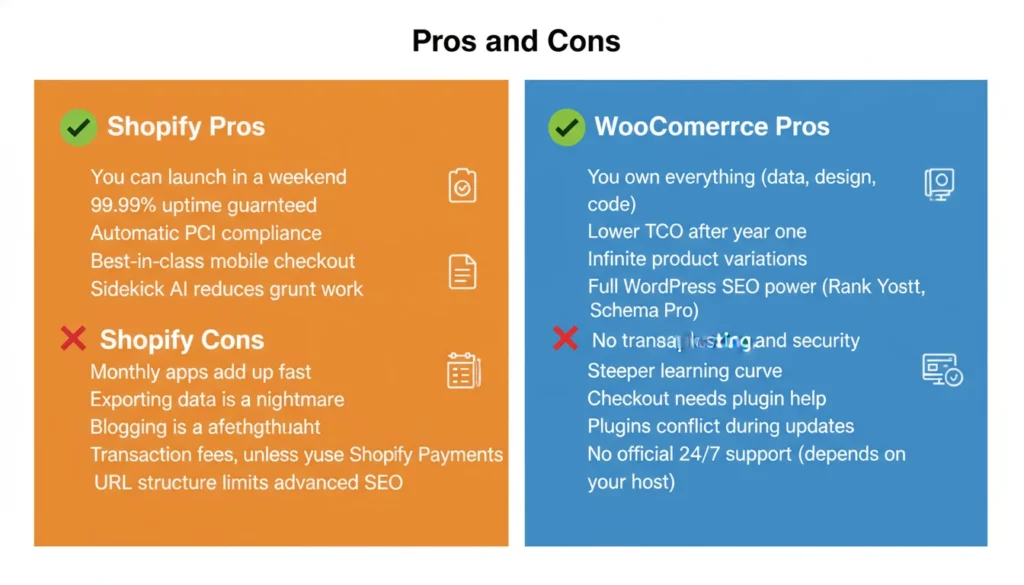
Shopify Pros
- You can launch in a weekend
- 99.99% uptime guaranteed
- Automatic PCI compliance
- Best-in-class mobile checkout
- Sidekick AI reduces grunt work
Shopify Cons
- Monthly apps add up fast
- Exporting data is a nightmare
- Blogging is an afterthought
- Transaction fees, unless you use Shopify Payments
- URL structure limits advanced SEO
WooCommerce Pros
- You own everything (data, design, code)
- Lower TCO after year one
- Infinite product variations
- Full WordPress SEO power (Rank Math, Yoast, Schema Pro)
- No transaction fees
WooCommerce Cons
- You manage hosting, speed, and security
- Steeper learning curve
- Checkout needs plugin help
- Plugins conflict during updates
- No official 24/7 support (depends on your host)
Conclusion
Stop asking “Which is better?” and start asking “Which is better for my business model, technical skills, and customer acquisition strategy?”
The WooCommerce vs Shopify in 2026 answer isn’t one-size-fits-all, and anyone who tells it to you is selling something.
Choose Shopify if:
- You want to be live this week
- You hate maintaining software
- Your primary traffic comes from TikTok, Instagram, or paid ads
- You sell fewer than 5,000 SKUs and under $1M/year
Choose WooCommerce if:
- SEO and content marketing drive your revenue
- You have (or will hire) WordPress expertise
- You sell complex products or over 10,000 variants
- You believe in digital sovereignty (own your data)
Here’s the truth most “gurus” won’t admit: both will work. But one will work faster. The other will work more cheaply. Your job is to prioritize which variable matters more in the next 12 months.
For the official word on each platform, visit WooCommerce.com and Shopify.com.